Looking for coloring pages for meditation that actually produce the focused, calming state research links to anxiety reduction? Coloring pages for meditation aren’t just “any” coloring book pages — specific design features make some pages dramatically more effective than others for entering and sustaining a meditative state. Here are the 5 best coloring pages for meditation styles, why they work, and how to structure a real practice.
What makes coloring pages for meditation different
Three design features research consistently links to deeper meditative states:
- Symmetric structure. Radial or grid symmetry reduces decision-making, accelerating flow state.
- Repetitive elements. Same shape repeated lets your brain settle into rhythm.
- Medium detail. Too simple = mind wanders. Too detailed = perfectionism kicks in. Medium is the sweet spot.
This is why the best coloring pages for meditation aren’t always the most beautiful Instagram-worthy ones. Some hyperdetailed art looks gorgeous but is too cognitively demanding for true meditation.
The 5 best coloring pages for meditation styles
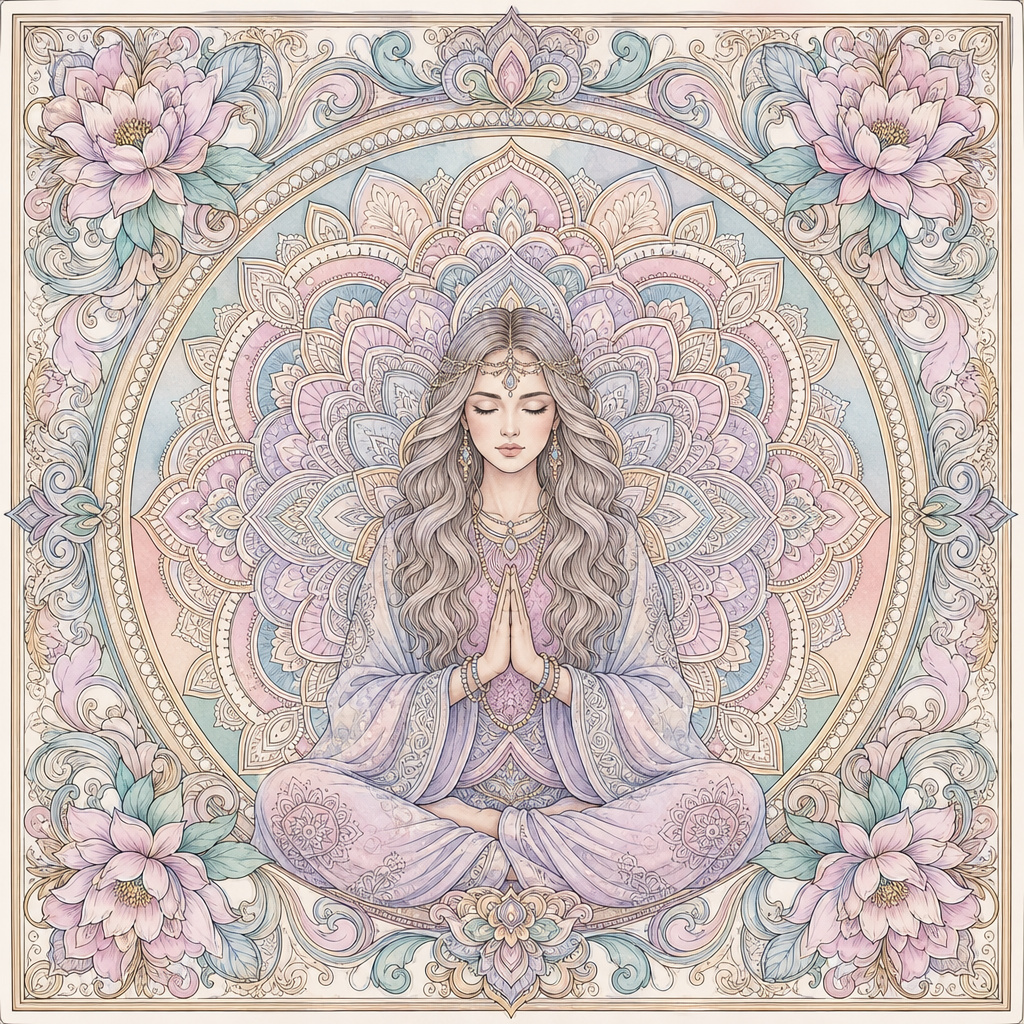
1. Classic mandalas (most-researched, top pick)
The 2017 study in Arts in Psychotherapy showed measurable reductions in state anxiety after 20-minute mandala coloring sessions. The radial structure + repetitive segments produce the strongest flow state of any coloring genre.
For mediation-specific work, choose:
- 6-12 ring mandalas (not 20+ — too complex)
- Medium-thick outlines (kid-friendly outlines hide drift)
- No animals, faces, or recognizable subjects in the center
See our mandala printables guide for sourcing high-quality designs.
2. Zentangle pages
Zentangle = pages filled with repeating small patterns (“tangles”) — dots, lines, scales, leaves. Highly meditative because each tangle is its own micro-task.
Why it works: sustained focus on small repeating shapes for 45-90 minutes per page. Time disappears completely during good zentangle sessions.
Best for: intermediate to advanced colorers who want the deepest possible meditation experience. Skip for beginners — overwhelming.
3. Geometric pattern pages
Non-mandala geometric designs: tessellations, sacred geometry, Islamic-style patterns, hexagonal grids. Pure pattern work without the central focus of mandalas.
Why it works: the repetition is everywhere, not just radial. Sustained attention across the whole page.
Best for: people who find pure mandalas boring, anyone interested in geometric beauty as part of the practice.
4. Botanical pattern pages (repetitive nature themes)
Repeating leaves, flowers, vines — structured but with natural variation. Easier than pure geometry while still maintaining the meditative repetition.
Why it works: nature themes pair the flow benefit with environmental psychology (humans relax around plant imagery). See our anxiety coloring picks for botanical-specific recommendations.
Best for: beginners to meditation coloring, anyone who finds pure geometry too “clinical.”
5. Cosmic / celestial pattern pages
Stars, moons, constellations, mandala-style cosmic designs. The “expanded perspective” feeling of gazing at the night sky, captured in coloring form.
Why it works: triggers similar mental state to actual stargazing. Pairs especially well with breath work alongside coloring.
Best for: evening sessions, anyone who finds outer-space imagery calming.
How to structure a real meditation coloring session
Four elements that distinguish meditation from casual coloring:
- Pre-session breathing. 2-3 minutes of slow nasal breath before starting. Sets the nervous system.
- Phone in another room. Notifications fundamentally break the meditation.
- Single page focus. Don’t flip through the book. Commit to one page.
- Minimum 20-30 minute commitment. Research-supported minimum dose.
The structure itself is part of the meditation, not just the coloring.
Best coloring pages for meditation — supplies that help
Specific supply choices that deepen the practice:
- Soft-core colored pencils. Smooth lay-down, low pressure. See our markers vs pencils guide.
- 24-color set max. Decision paralysis kills meditation. Limit choices intentionally.
- Quality paper. Cardstock or heavyweight printer paper. Cheap paper interrupts flow with friction. Our paper guide covers right weights.
- Manual pencil sharpener. The act of sharpening becomes part of the rhythm.
Skip premium 100+ color sets for meditation work. The constraint is the practice.
Session length and frequency
| Practice level | Session length | Frequency |
|---|---|---|
| Beginner | 15-20 min | 3x/week |
| Established practice | 30-45 min | 4-5x/week |
| Deep practice | 60-90 min | Daily |
| Retreat-style | 2-3 hours | Weekend single session |
Research-supported minimum is 20 minutes for measurable state-anxiety reduction. Most practitioners settle into 30-45 minute sessions 3-5x per week.
Pairing coloring pages for meditation with breathing
Three breathing techniques that combine well with coloring:
- Box breathing. Inhale 4, hold 4, exhale 4, hold 4. Repeat throughout the session.
- 4-7-8 breathing. Inhale 4, hold 7, exhale 8. Triggers parasympathetic activation.
- Coloring-rhythm breathing. Inhale on the down-stroke of pencil, exhale on the up-stroke. Synchronizes breath to action.
The Wikipedia overview of meditation covers the broader research base on attention-focused practice — useful framing for thinking about coloring meditation alongside other techniques.
Common coloring pages for meditation mistakes
- Picking too-detailed pages. Hyperdetailed work triggers perfectionism — antithetical to meditation.
- Switching pages mid-session. Break the flow state every time.
- Coloring with notifications on. Phone access defeats the entire purpose.
- Treating it like a deliverable. No goal, no result. Just the process.
- Forcing a state. Some sessions are flow; others aren’t. Don’t pressure yourself.
How long until coloring pages for meditation produces real benefit
Research suggests measurable state-anxiety reduction after a single 20-minute session. Trait-anxiety (longer-term) changes require 3-4 weeks of regular practice.
Expected timeline:
- Session 1: Notice you’re less wound-up after
- Week 2-3: Coloring becomes a “treat” rather than a chore
- Week 4-8: Reduced baseline anxiety, easier sleep
- Month 3+: Established practice that maintains the benefit indefinitely
See our 30-day anxiety experiment for personal documentation of this curve.
FAQ
Are coloring pages for meditation the same as art therapy? Related but different. Art therapy involves a clinician interpreting the work. Coloring meditation is solo, process-focused practice.
Can I listen to music during coloring meditation? Soft ambient music or nature sounds enhance the practice. Avoid music with lyrics — the brain processes them and breaks meditation.
Is digital coloring as effective? Generally less effective than physical. Screen exposure and notification temptations work against the calm state.
Do I need to finish a page in one session? No — multi-session pages are fine. Just resume in the meditative mindset, don’t try to “finish” with pressure.
What if I don’t enter a meditative state? Normal. Most sessions are partial flow, not deep meditation. Showing up is the practice.
Bottom line
The 5 best coloring pages for meditation styles: classic mandalas, zentangle pages, geometric patterns, repetitive botanicals, and cosmic/celestial designs. Skip hyperdetailed art and animal/face-centered designs for meditation specifically. Structure sessions with pre-breathing, phone away, single-page focus, 20-30+ minutes. Pair with breath techniques. Expect first benefits after a single session and established practice gains over 3-4 weeks of consistent work.