I’ll be honest with you. When I first heard about adult coloring for anxiety, my reaction was somewhere between “okay, sure” and “really?” It felt a little too simple. Color in some lines for 20 minutes and your nervous system calms down? That’s the pitch?
So I did what I do with most claims like this. I went looking for the research on adult coloring for anxiety, and then I tested it on myself for 30 days. The results landed somewhere I didn’t expect — not “this is a miracle cure,” but also not “this is hippie nonsense.” Here’s everything I found.

What the Research Says About Adult Coloring for Anxiety
The first study I want to mention is from way back in 2005, by psychologists Nancy Curry and Tim Kasser. They had a group of college students rate their anxiety, then assigned them to either color a mandala, color a plaid pattern, or do free-form coloring on a blank page. Twenty minutes later, only the mandala-coloring group showed a significant drop in anxiety. The “color whatever you want” group barely changed.
That’s an interesting wrinkle. It wasn’t coloring in general that helped — it was coloring something structured. The researchers thought the structure gave the brain a kind of focus point, like a visual meditation. A guess, but a reasonable one. You can read the original Curry & Kasser study here.
Fast forward to 2017, when a study in Art Therapy: Journal of the American Art Therapy Association looked at the same question with adults instead of college students. Same finding. Adults coloring mandalas (or geometric patterns) for as little as 10 minutes lowered self-reported anxiety. Here’s that one.
And in 2018, a brain-imaging study used near-infrared spectroscopy to show that mandala coloring activates the prefrontal cortex — the part of your brain that handles focus and emotional regulation — in a way that resembles low-level meditation. Not “the same as meditation,” just rhyming.
So the picture across the research on adult coloring for anxiety is pretty consistent. Structured coloring (mandalas, geometric patterns, detailed botanical art) tends to drop anxiety in the short term. It’s not a cure for clinical anxiety disorders. It’s a small, repeatable intervention that lowers your baseline a bit, kind of like how a 10-minute walk does.
Why It Probably Works
This part is more guess than proven, but here’s the working theory:
- Coloring is mildly cognitively demanding without being stressful. You can’t doomscroll while you’re choosing the next color for petal #14.
- The repetitive, structured nature of mandalas keeps your brain from drifting back into rumination — the loop of “what if X happens” that powers most anxiety.
- You’re using your hands. Manual tasks are weirdly good for the nervous system. There’s a reason knitting and pottery have stuck around.
- You finish something. Most modern stress comes from open loops — emails you haven’t answered, decisions you haven’t made. Finishing a coloring page closes a loop in a low-stakes way.
That’s not a clinical trial, that’s a hand-wave. But it matches what I felt during my own test.
My 30-Day Adult Coloring Experiment
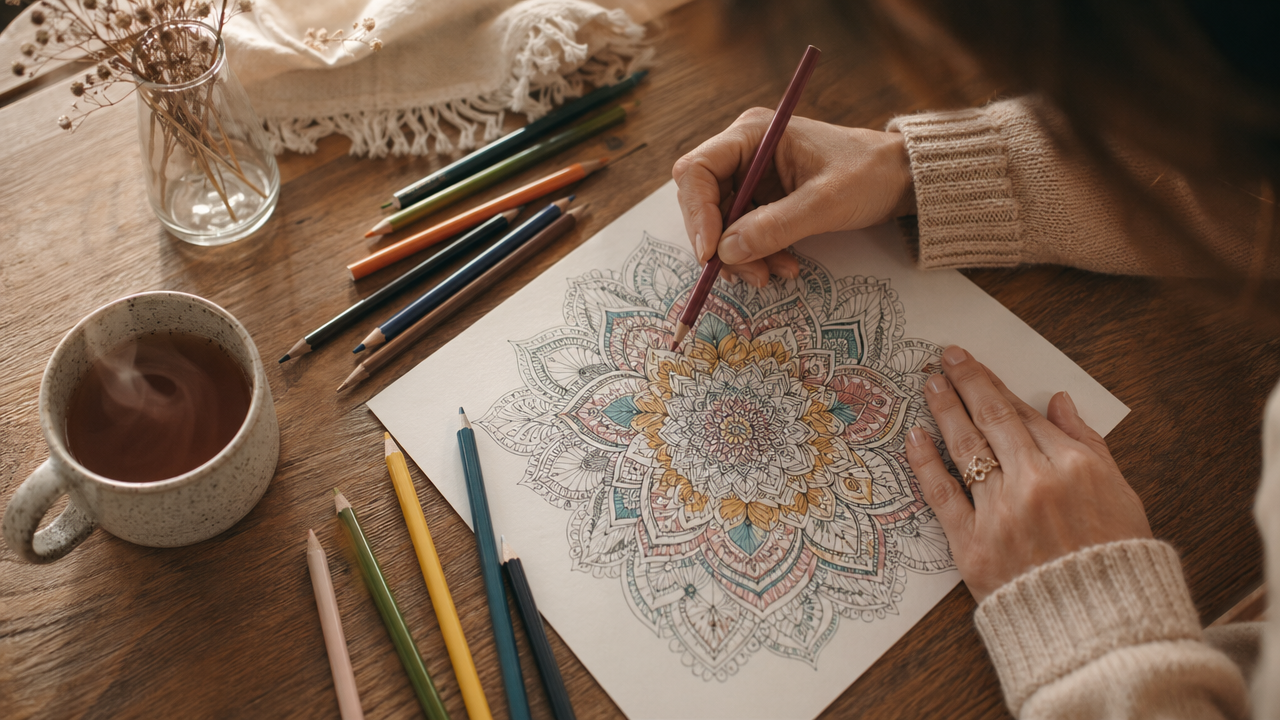
I picked one rule for my adult coloring for anxiety test: 20 minutes of structured coloring per day, ideally before bed, no exceptions. I used a mix of mandalas and detailed botanical pages. No phone in the room. Just me, colored pencils, and the page.
Week one was awkward. I kept thinking “this is a waste of 20 minutes.” But I noticed I was sleeping a little faster — maybe 10 minutes instead of 30. Hard to attribute that just to coloring, but it tracks.
Week two, I started looking forward to it. Honestly. The same way I look forward to a hot shower at the end of a long day. It became something I did instead of doomscrolling, and the difference was obvious.
Weeks three and four blurred together. Sleep was clearly better. My average bedtime got earlier without me trying. The big surprise wasn’t that anxiety went down on the days I colored — it was that I started noticing anxiety more clearly on the days I skipped. Like the routine gave me a baseline to compare against.
None of this is a controlled experiment. It’s an n=1 with a lot of confounders. But if you’ve been wondering whether adult coloring for anxiety is worth trying — for me, the answer was yes.
What to Color (And What Probably Won’t Work)
Based on the research, what you color matters more than I expected. Here’s the rough hierarchy:
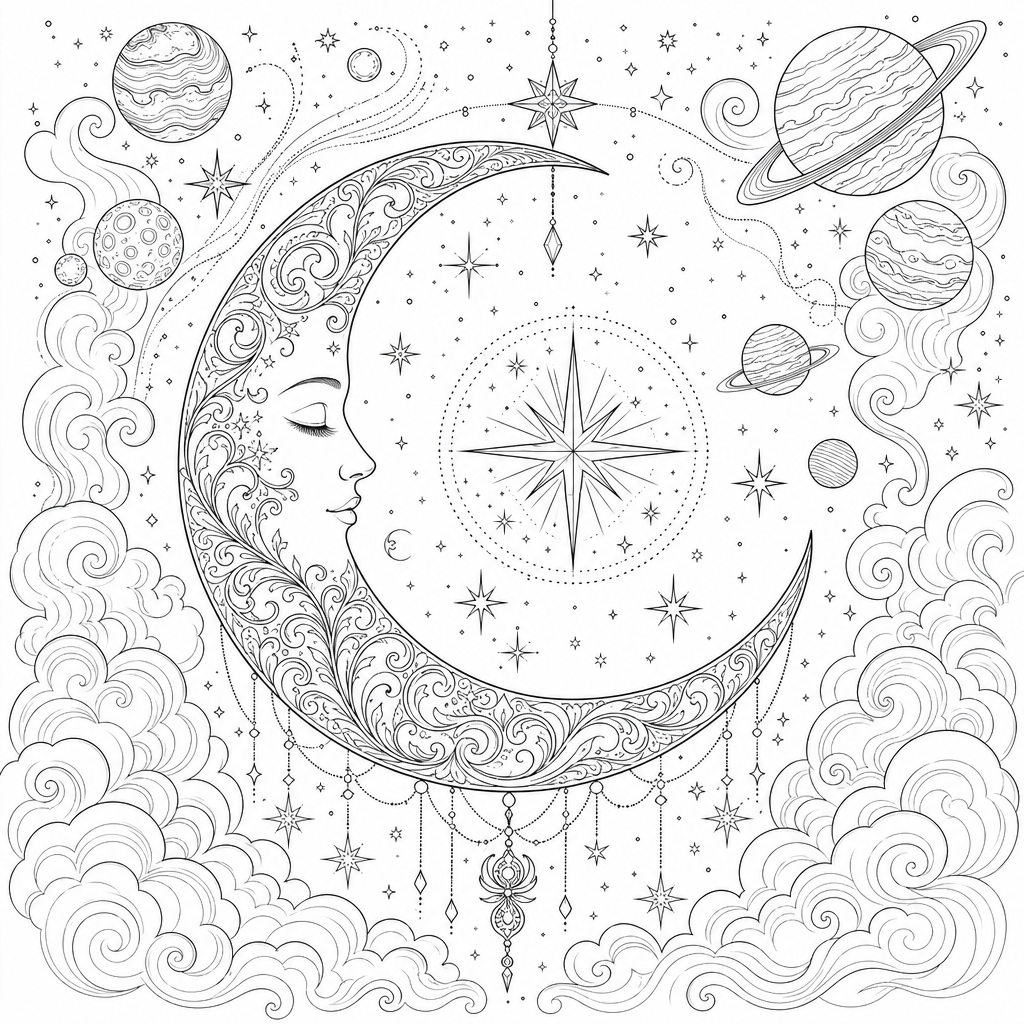
- What works best: Mandalas, geometric patterns, intricate botanical illustrations, detailed celestial designs. The common thread is structure — there’s a clear “right” answer for what to color where, even if you’re choosing your own colors.
- What works less well: Free-form blank pages, very simple kid-style coloring books with big easy shapes. Not bad, just less anxiolytic.
- What probably doesn’t work at all: Coloring with your phone in your hand, half-watching TV, trying to multitask. The whole point is single-pointed focus.
If you want to try it, I’d suggest starting with mandalas. They have the most research behind them, and there’s something about the symmetry that does feel quieting once you settle in. We make a Mandala Magic adult coloring book if you want a low-cost ($1.99) instant download to start with — but honestly, any mandala book works. Print, color, see what happens.
If mandalas aren’t your thing, detailed botanical pages have the same effect. Our Enchanted Botanical Garden book is built around the same idea — structured intricate pages that give your brain something to focus on.
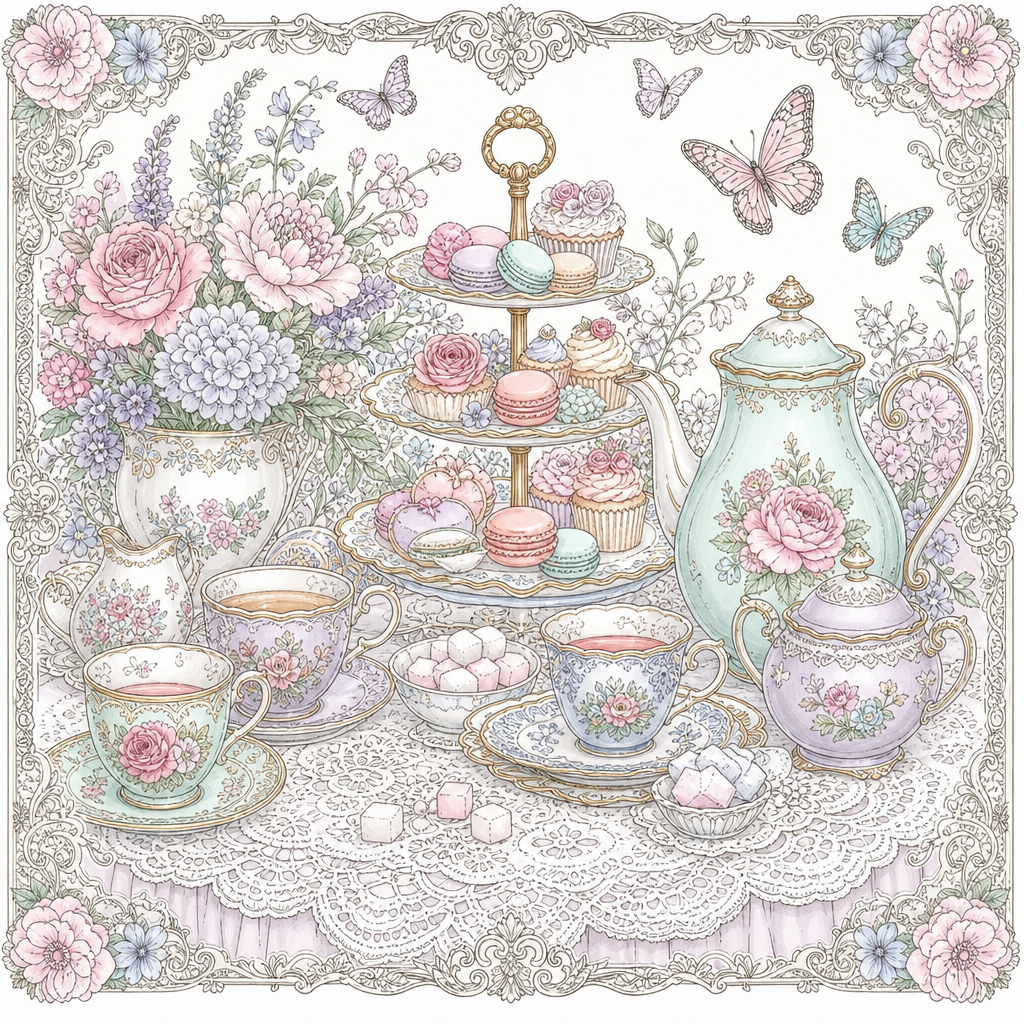
And if you want something a little more whimsical, the Celestial Dreams and Whimsical Tea Party books work well too. The structure’s still there, just dressed up differently.
How to Actually Build the Habit
I want to skip the usual “build a habit by doing it daily!” speech because if it were that easy, you’d already be doing it. Here’s what actually worked for me.
Make it the easiest thing in the room. I left a printed page, a small case of colored pencils, and a sharpener on my nightstand. No drawer, no closet. If it’s harder to start than to scroll, you’ll scroll.
Pair it with something already happening. I colored after brushing my teeth, every night. The teeth were the trigger; the coloring was the reward. James Clear calls this habit stacking and it works.
Don’t aim for perfection. Some nights I colored for 5 minutes, not 20. That still counted. Trying to be perfect about a calming routine is, ironically, anxiety-inducing.
Track it for a month, then decide. A month is enough to know if it’s helping. If by day 30 it feels like a chore, drop it. Real habits feel like relief, not obligation.
Who This Won’t Work For
This isn’t medical advice and I’m not pretending it is. If you’re dealing with clinical anxiety or panic disorder, adult coloring is not a substitute for therapy or medication. It might be a useful add-on, but you should talk to a real professional, not a blog post. The research on adult coloring for anxiety is about everyday anxiety — the background hum that most adults carry around, not full-blown anxiety disorders.
That said, if you’re in the “low-grade-stressed-most-of-the-time” club like most of us, give it a real try. 20 minutes a day for 30 days. The downside is small. The upside, in my n=1 case, was real.
The Tl;dr on Adult Coloring for Anxiety
- Research consistently shows that structured coloring (mandalas especially) lowers self-reported anxiety in 10–20-minute sessions.
- Adult coloring for anxiety is not a cure for clinical anxiety. It’s a small, repeatable habit that nudges your nervous system in a calmer direction.
- What you color matters. Structure beats free-form.
- The hardest part is starting. Make it the easiest thing in your room and pair it with an existing habit.
- 30 days is the right length to test it. Track how you feel, then decide.
If you want to try the experiment yourself, you can grab any of our printable adult coloring books and have it on your printer in 5 minutes. The whole thing costs less than a coffee.
Have you tried adult coloring for anxiety? I’d love to hear what worked and what didn’t. Drop a comment below.

Every Squiggle Press book — 40 printable PDFs for $9.99
Kids coloring books, adult coloring books, drawing tutorials & sticker packs. $160 value. Print unlimited copies forever.
Get the bundle →