If your kitchen table has ever been covered in scribbled rockets, lopsided planets, and stars that look suspiciously like ninja stars, you already know how much kids love space drawing. Space drawing for kids is one of the easiest ways to turn a rainy afternoon into a launch pad for creativity — no fancy art supplies required, just paper, something to color with, and a little imagination. In this guide, we’ll break down simple shapes for rockets, planets, and stars that kids of almost any age can follow with confidence.
The short answer: space drawing for kids in a nutshell
Space drawing for kids works best when you break each subject into basic shapes: circles for planets, triangles and rectangles for rockets, and simple star outlines built from two overlapping triangles. Start big, keep lines loose, and let kids add their own colors and details — no drawing is “wrong” in outer space.
If your child is brand new to drawing, tracing or coloring printable space pages first (before freehand drawing) builds the confidence to try it on their own. Think of it less like an art lesson and more like a game with no losing moves — every rocket flies, every planet is real, and every star gets to sparkle exactly the way your child imagines it.
Why space is such a great drawing theme for kids
Space drawing for kids hits a sweet spot: it’s imaginative enough to spark storytelling, but structured enough to teach real shape and composition skills. Kids can invent planets no scientist has ever seen, name their own constellations, and send rockets to places that don’t exist yet — all while practicing circles, lines, and spatial planning.
According to child development research summarized by the American Academy of Pediatrics, open-ended creative play like drawing supports problem-solving, fine motor skills, and emotional expression in young children (healthychildren.org). Space themes, with their built-in sense of wonder, tend to keep kids engaged far longer than more literal subjects like “draw your house.”
There’s also a practical bonus that a lot of parents don’t expect: space drawing quietly teaches planning skills. Deciding where the rocket goes, how big the planet should be, and how many stars fit on the page all require a bit of forward thinking — the same kind of spatial reasoning kids will later use for map-reading, puzzles, and even basic geometry. None of that needs to be explained to your child, of course. From their point of view, they’re just drawing a spaceship.
What ages can try space drawing for kids?
Space drawing for kids works across a wide age range, but the approach should flex with developmental stage:
- Ages 3-5: Focus on big shapes and coloring pre-drawn outlines rather than freehand drawing.
- Ages 6-8: Introduce simple step-by-step breakdowns (circle, triangle, add details).
- Ages 9-12: Add shading, patterns on planets, and more detailed rocket parts like fins and windows.
None of these age ranges are strict rules. Some five-year-olds are already confidently sketching stick-figure astronauts, while some ten-year-olds still prefer coloring over freehand drawing — and that’s completely fine. The goal of space drawing for kids isn’t to hit a milestone on schedule; it’s simply to keep the pencil moving and the imagination engaged.
What you need before you start
One of the best things about space drawing for kids is how little it requires. A basic setup keeps kids focused instead of hunting for supplies mid-project. Here’s a simple starter list:
| Supply | Why it helps |
|---|---|
| Plain or dark paper | Dark paper makes stars and planets pop with light-colored pencils or chalk |
| Pencil for sketching | Lets kids erase and adjust rocket shapes before committing to color |
| Crayons, markers, or colored pencils | For filling in planets, flames, and starry skies |
| Printable guide sheets | Great for beginners who want structure before freehand drawing |
If you’d rather skip the setup entirely, browse the free coloring pages on Squiggle Press — several space-themed sheets are ready to print today, no drawing skills required. Keeping supplies in one small bin or tray, rather than scattered across a few drawers, also saves a surprising amount of time and frustration once the creative momentum kicks in and your child wants to start right away.
How to draw a rocket in 4 easy steps
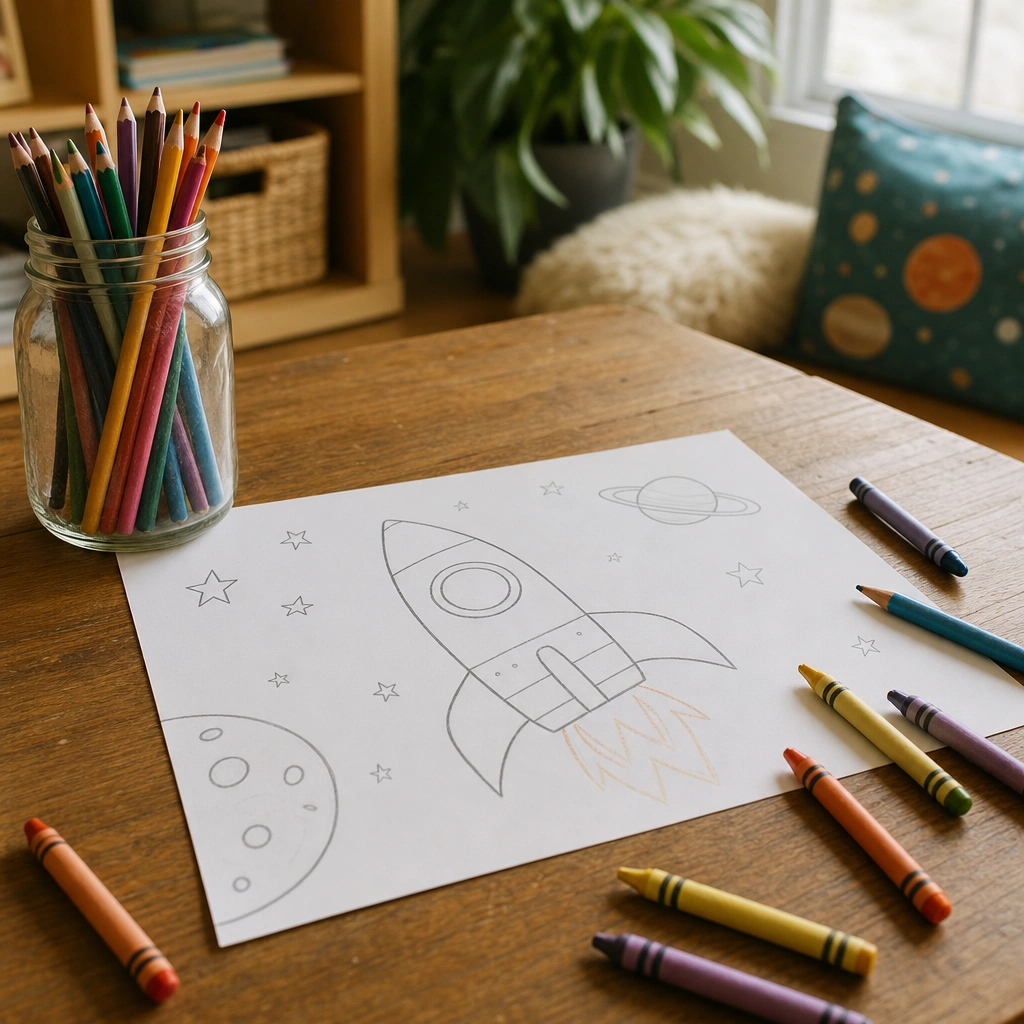
Rockets are the perfect entry point for space drawing for kids because they’re really just a stack of simple shapes. Here’s a beginner-friendly breakdown:
- Draw the body: A tall rectangle with a rounded top, like a capsule shape.
- Add the nose cone: A triangle on top of the rectangle to form the pointy tip.
- Attach the fins: Two small triangles at the base, angled outward like wings.
- Add flames and details: Squiggly orange and yellow shapes underneath for exhaust, plus a round window and stripes on the body.
Encourage kids to exaggerate the flames or add extra boosters — accuracy matters far less than enthusiasm here. This is space drawing for kids at its most joyful: silly, colorful, and totally their own.
If your child wants to push the rocket further, try adding a second, smaller rocket in the background, or a launch tower made of simple straight lines. Layering in extra details like this is a gentle way to introduce the idea of a full scene rather than a single subject, and it rarely feels like “more work” to a kid who’s already having fun.
How to draw planets kids will love
Planets are essentially circles with personality, which makes them low-pressure and highly rewarding for young artists. Try this simple sequence:
- Draw a circle (tracing a cup or lid works great for younger kids).
- Add a ring around it at an angle, like a tilted oval, for a Saturn-style look.
- Fill the circle with swirls, dots, or stripes — real planets or completely made-up ones.
- Add 2-3 small dots or moons orbiting nearby.
For older kids, introduce basic shading: a dark crescent on one side of the planet suggests it’s lit by a “sun” off to one side, adding surprising depth for very little extra effort.
Fun planet variations to try in your space drawing for kids sessions
- Striped gas giants with swirling bands of color
- Polka-dot planets with craters made from simple circles
- “Candy planets” colored like favorite snacks — a hit with younger kids
One trick that works surprisingly well: ask your child to name their planet before they draw it. A planet called “Bubblegum World” or “Ice Cream Moon” almost always ends up with a distinct color palette and pattern, because the name gives the drawing a little story to follow. It turns a blank circle into a character.
How to draw stars that actually look like stars
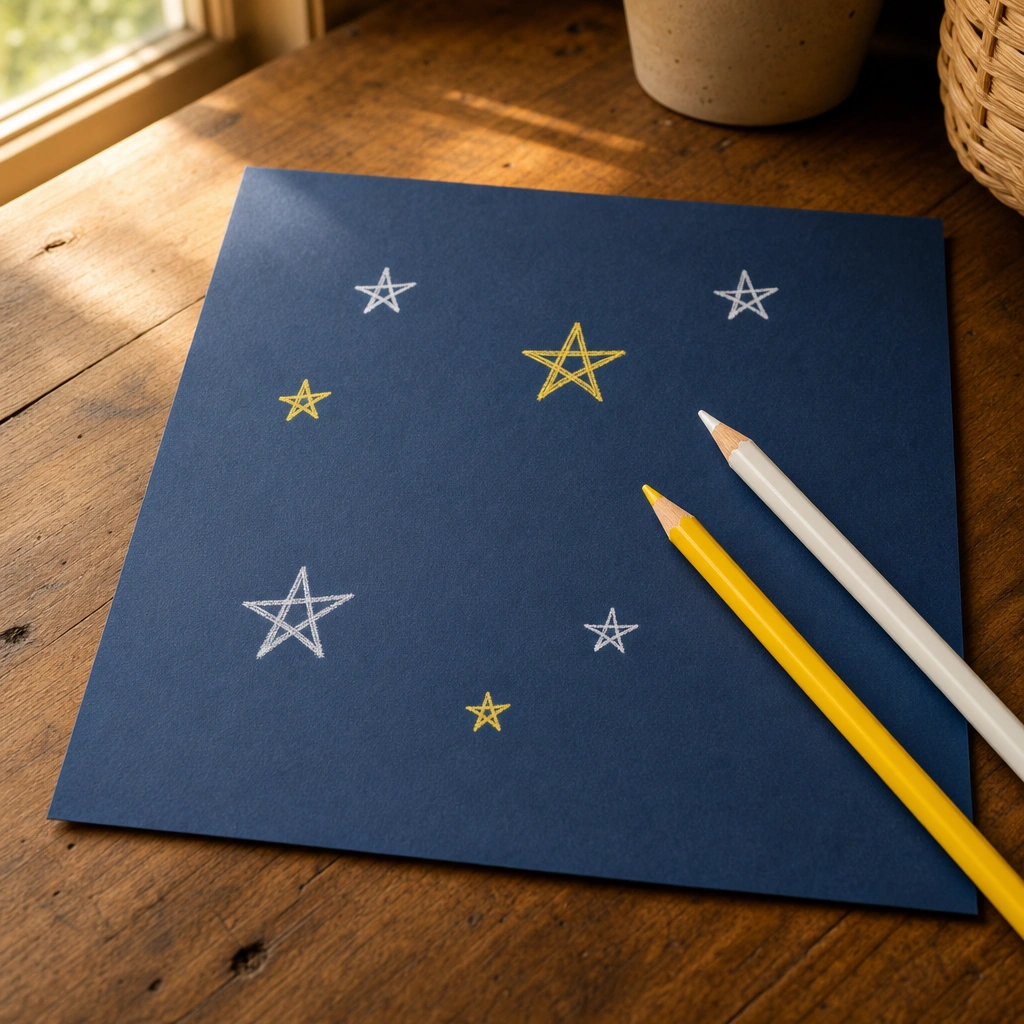
Stars trip kids up more than you’d think, but there’s an easy trick. Space drawing for kids gets much simpler once you show them this two-triangle method:
- Draw one triangle pointing up.
- Draw a second triangle pointing down, overlapping the first to form a six-pointed star.
- Erase the overlapping lines in the middle for a clean star shape.
Alternatively, younger kids can simply draw a plus sign (+) and an X on top of it, then connect the points — a five-point star with almost no fine motor strain. Scatter a handful of these across the page in different sizes for an instant night sky.
For an extra bit of sparkle, try adding tiny cross-shaped “twinkle” marks near a few of the stars, or a thin colored outline in a contrasting shade. It’s a small detail, but it makes a night sky feel finished rather than just scattered with shapes.
Combining rockets, planets, and stars into one scene
Once kids have practiced each shape separately, putting them together into one space scene is where the real magic happens. A simple composition tip: place the rocket at an angle (not perfectly straight up) for a sense of motion, add 1-2 large planets in the background, and scatter stars to fill empty space.
This is also a great moment to introduce basic layering — objects that overlap appear closer, and smaller shapes appear farther away. It’s a gentle, low-stakes way to teach depth and perspective through space drawing for kids without ever using those words.
If your child is drawing a full scene for the first time, it can help to build it in a specific order rather than tackling everything at once. Start with the biggest shape (usually a planet or the rocket), add the second-largest element next, and finish with the smallest details like stars and flames last. This keeps the page from feeling too crowded too quickly, and it gives kids a natural sense of “big idea first, details later” that carries over into other kinds of drawing too.
Simple color palette ideas
| Mood | Color Palette |
|---|---|
| Classic night sky | Navy background, yellow stars, red/white rocket |
| Sunset launch | Orange, pink, purple gradient sky |
| Alien world | Green sky, purple planets, glowing pink stars |
Coloring pages: the gentle on-ramp to space drawing for kids
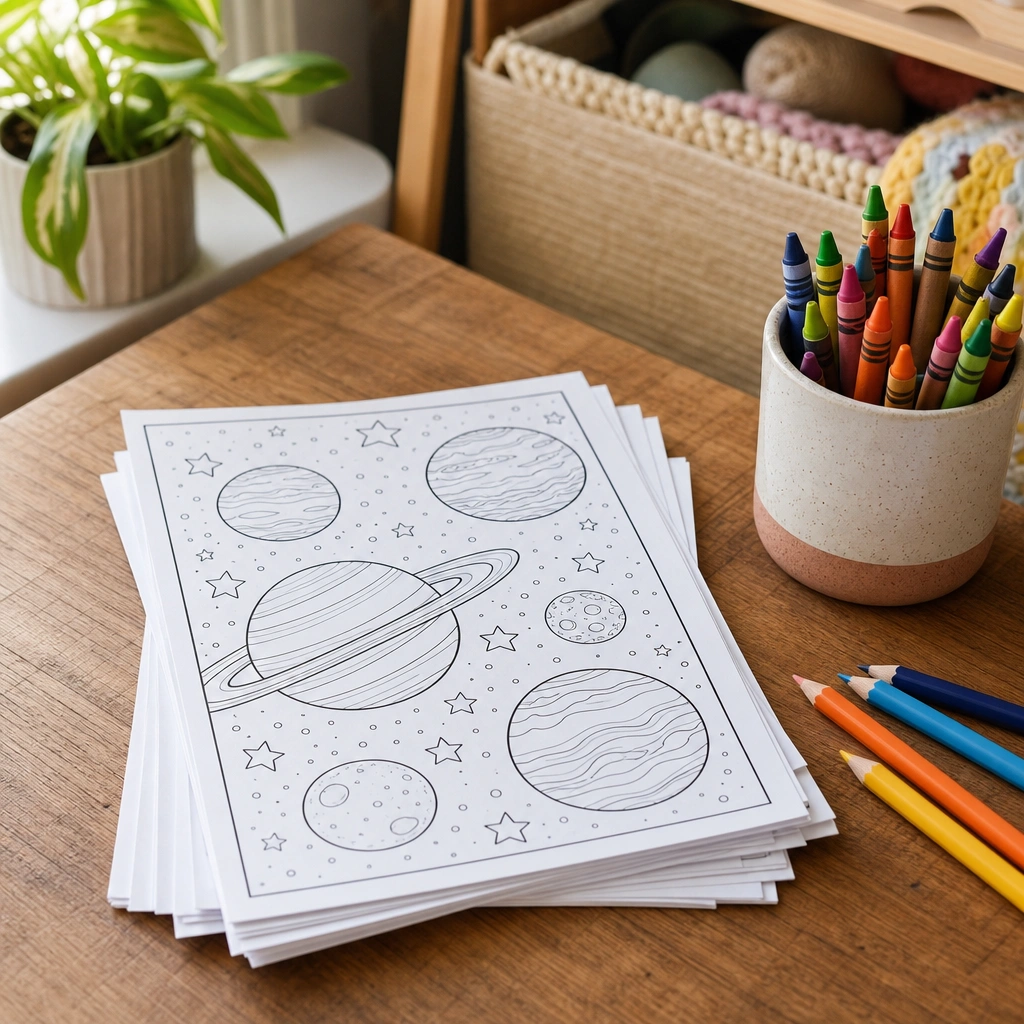
Not every child wants to draw freehand right away, and that’s completely normal. Coloring printed line art is a proven bridge between “I can’t draw” and “I love drawing” — kids get to make real creative choices (color, shading, patterns) without the pressure of getting the shapes right first.
If your child colors mostly at home, it might be worth setting up a dedicated spot for supplies — our guide on organizing a coloring supply station has simple, budget-friendly ideas. And once the masterpiece is finished, check out how to photograph finished coloring pages for tips on capturing it well before it inevitably ends up under a pile of homework.
Printable resources that make space drawing for kids even easier
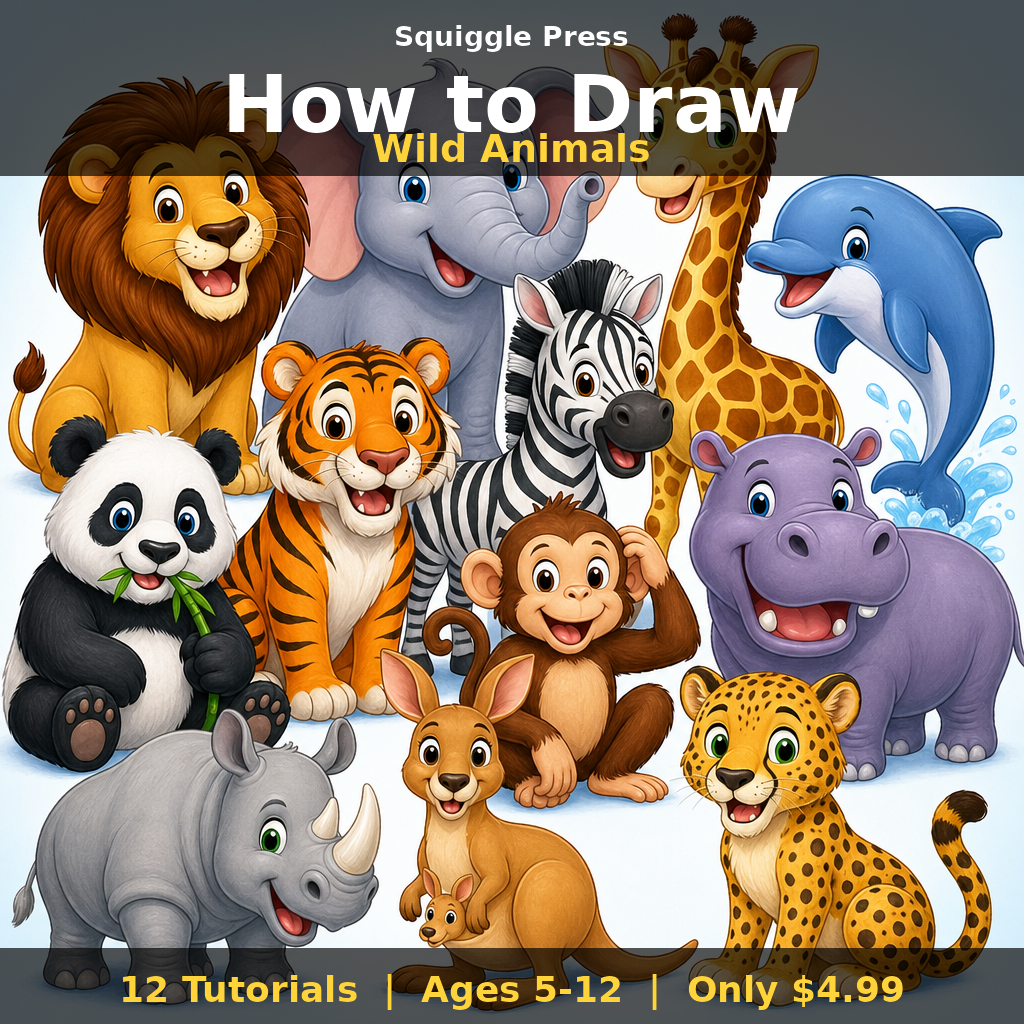
If you want ready-made step-by-step guidance rather than starting from a blank page, printable drawing tutorials are a great next step. While we don’t currently have a dedicated space pack, a few of our existing instant-download PDFs use the exact same step-by-step, shape-based teaching method that works so well for space drawing for kids:
- How to Draw Dragons for Kids ($1.99, instant PDF download) — teaches kids to build complex creatures from simple shapes, the same skill that makes rockets and planets easy.
- How to Draw Cute Sea Animals ($1.99, instant PDF download) — another great step-by-step confidence-builder for young artists.
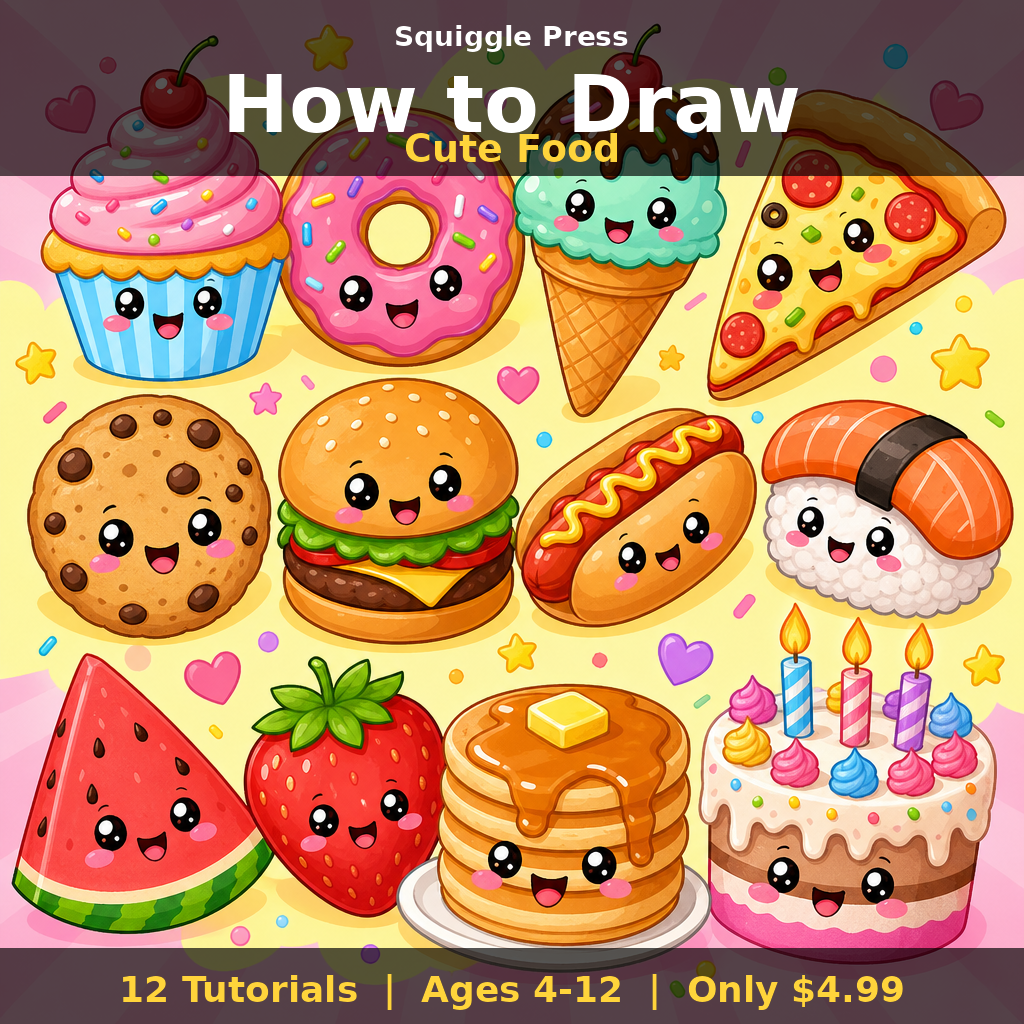
- How to Draw Cute Food ($4.99, instant PDF download) — a fun, low-pressure way to keep practicing shape-based drawing between space sessions.
You can browse the full collection of printable coloring books, drawing tutorials, and sticker packs at Squiggle Press’s shop — everything downloads instantly as a PDF, ready to print at home.
Tips for keeping little astronauts motivated
Space drawing for kids can lose steam if a rocket “doesn’t look right” or a planet feels wobbly. A few gentle strategies help:
- Praise effort, not accuracy: “I love how big and bold your flames are!” beats “that’s not how rockets look.”
- Offer a redo, not a critique: Fresh paper is cheap; a discouraged artist is not.
- Mix drawing with coloring: Alternate freehand attempts with printable pages so kids always feel successful.
- Keep sessions short: 10-15 minutes is plenty for younger kids before attention drifts.
According to guidance from the Centers for Disease Control and Prevention on early childhood development, process-focused creative activities (rather than outcome-focused ones) support confidence and persistence in young children (cdc.gov). Space is a naturally forgiving subject — nobody actually knows what an alien planet looks like, so there’s no “wrong” answer.
It also helps to resist the urge to “fix” a child’s drawing, even with the best intentions. Adding a few adult pencil strokes to straighten a rocket or round out a planet can unintentionally send the message that their version wasn’t good enough. Letting the wobble stay is usually the better move — it’s proof the drawing is genuinely theirs.
Turning space drawings into a mini routine
Some families find it helpful to build a short creative habit around a theme like space, rotating it into an existing after-school or weekend rhythm rather than treating it as a one-off activity. If you’re looking for structure ideas, our post on building a coloring routine for kids after school has practical, low-effort suggestions that adapt easily to drawing sessions too.
A simple weekly rhythm might look like: rockets on Monday, planets on Wednesday, and a full combined scene on the weekend. There’s no need to be strict about it — the point of the routine is just to make space drawing for kids feel like a familiar, low-pressure part of the week rather than something that has to be planned from scratch every time.
Beyond rockets: expanding the space theme
Once kids feel confident with the basics, there’s a lot of room to grow within the space theme. A few easy next steps:
- Astronauts (simple round helmets and puffy suits — easier than they look)
- Alien creatures (great for combining shapes in silly, unpredictable ways)
- Space vehicles like rovers or satellites (rectangles and circles, again!)
- Comets and shooting stars (a curved line with a star at the tip)
Letting kids choose which element to try next keeps space drawing for kids feeling like play rather than a lesson — which, developmentally, is exactly the point. If your child gravitates toward one particular element — say, they can’t stop drawing aliens — that’s a good sign, not a distraction. Following their interest usually produces more focused, detailed work than steering them back toward a “balanced” scene.
Common questions about space drawing for kids
A few questions come up often enough that they’re worth answering directly, especially for parents trying this for the first time.
Does my child need to know real facts about space first? Not at all. Space drawing for kids works just as well — often better — when it’s rooted in imagination rather than accuracy. Made-up planets and impossible rockets are part of the fun.
What if my child only wants to trace, not draw freehand? That’s a completely valid stepping stone. Tracing builds the same hand control and shape recognition that freehand drawing needs, and many kids naturally graduate to freehand work once they feel steady with the basics.
How do I keep siblings of different ages drawing together? Give everyone the same theme but let each child pick their own difficulty level — a five-year-old coloring a printable rocket next to a ten-year-old freehand-sketching one works fine, since the shared theme keeps them connected without forcing the same skill level.
Quick troubleshooting guide
| Problem | Simple Fix |
|---|---|
| Rocket looks “wonky” | Draw guide shapes lightly in pencil first, then trace over favorites in marker |
| Planet circles come out lopsided | Trace a lid, cup, or coin for a perfect circle |
| Stars look messy | Try the plus-sign-and-X trick instead of freehand points |
| Kid says “I can’t draw” | Switch to a printable coloring page for a quick creative win |
Final thoughts on space drawing for kids
Space drawing for kids doesn’t need to be complicated to be meaningful. A wobbly rocket, a striped planet, and a handful of stars scattered across the page are more than enough to build real drawing confidence — and a lot of giggles along the way. Start with simple shapes, keep the mood playful, and let curiosity do the rest.
Whether your child ends up freehand-sketching entire galaxies or simply enjoys coloring a printable rocket page while snuggled on the couch, the goal is the same: a little creative joy, no pressure attached.
Ready to print some fun?
Browse our printable coloring books, drawing tutorials & sticker packs — instant PDF downloads from $1.99, plus totally free tutorials to try first.

Every Squiggle Press book — 40 printable PDFs for $9.99
Kids coloring books, adult coloring books, drawing tutorials & sticker packs. $160 value. Print unlimited copies forever.
Get the bundle →