If your kid has ever roared through the living room pretending to be a T. rex, chances are they’ve also asked you to draw one — and frozen the crayon in your hand with panic. Good news: learning how to draw a dinosaur for kids is way easier than it looks once you break it down into simple shapes. In this guide, we’ll walk through a friendly, no-pressure, step-by-step method that works for preschoolers, big kids, and honestly, grown-ups who “can’t draw” either. By the end, you’ll have a full toolkit — shapes, steps, troubleshooting, and printable follow-ups — for making dinosaur drawing a regular, low-stress activity in your house.
To draw a dinosaur for kids, start with two ovals (body and head), connect them with a curved neck, add four thick leg shapes, a long tapered tail, then finish with triangle spikes, a smiling mouth, and an eye. Build the whole picture from simple circles, ovals, and triangles before adding any details — that’s the secret every kid-friendly tutorial relies on.
The Short Answer: How to Draw a Dinosaur for Kids
The fastest way to learn how to draw a dinosaur for kids is to build it from basic shapes first: an oval for the body, a smaller oval for the head, a curved line for the neck, thick rectangle-ish legs, and a tapering tail. Once the shape “skeleton” is down, add fun details like spikes, teeth, or scales. This shape-first method removes the scary blank-page feeling and turns a complicated animal into something any kid can tackle in under ten minutes.
This is also the same basic approach used in most children’s art classes, and once your child learns it, they’ll start noticing shapes hiding inside every animal they try to draw next — birds, dogs, even dragons.
Why Shapes Make Dinosaur Drawing So Much Easier
Kids often think drawing means getting every detail perfect on the first try, which is exactly what makes them give up. Breaking a dinosaur into circles, ovals, and triangles takes the pressure off. It’s the same approach art teachers use when teaching young children to draw animals, and it works because shapes are something kids already know how to make. If your child can draw a circle and a banana shape, they can draw a dinosaur.
According to early childhood drawing research, children’s drawing skills develop in predictable stages, moving from scribbles to basic shapes to combined forms — which is exactly why this method matches how kids naturally learn (HealthyChildren.org, American Academy of Pediatrics).
There’s also a confidence piece here that matters more than most parents realize. When a child is asked to draw a “realistic” dinosaur, their inner critic shows up fast, especially after age six or seven. But when the instruction is simply “draw a circle, now draw a bigger oval,” there’s no way to get it wrong. That small shift in language — from “draw a dinosaur” to “draw some shapes” — is often the difference between a kid who finishes the page and one who crumples it up.
This is also why so many kids get stuck the moment an adult hands them a “how to draw” book aimed at teenagers or grown-ups. Those books often skip straight to shading, proportion, and anatomy, which can be genuinely discouraging for a six-year-old who just wants to make something that looks like a dinosaur in the next five minutes. The shape method keeps the whole process age-appropriate without watering down the fun.
What You’ll Need to Draw a Dinosaur
- Plain paper or printer paper
- A pencil (or a crayon if your little one is past the pencil stage)
- An eraser — mistakes are part of the fun
- Crayons, markers, or colored pencils for the finishing touches
That’s genuinely it. No fancy art supplies required, though if you want a no-mess head start, our free coloring pages library has printable dinosaur pages your child can trace or color right alongside this tutorial.
How to Draw a Dinosaur for Kids: 7 Easy Steps
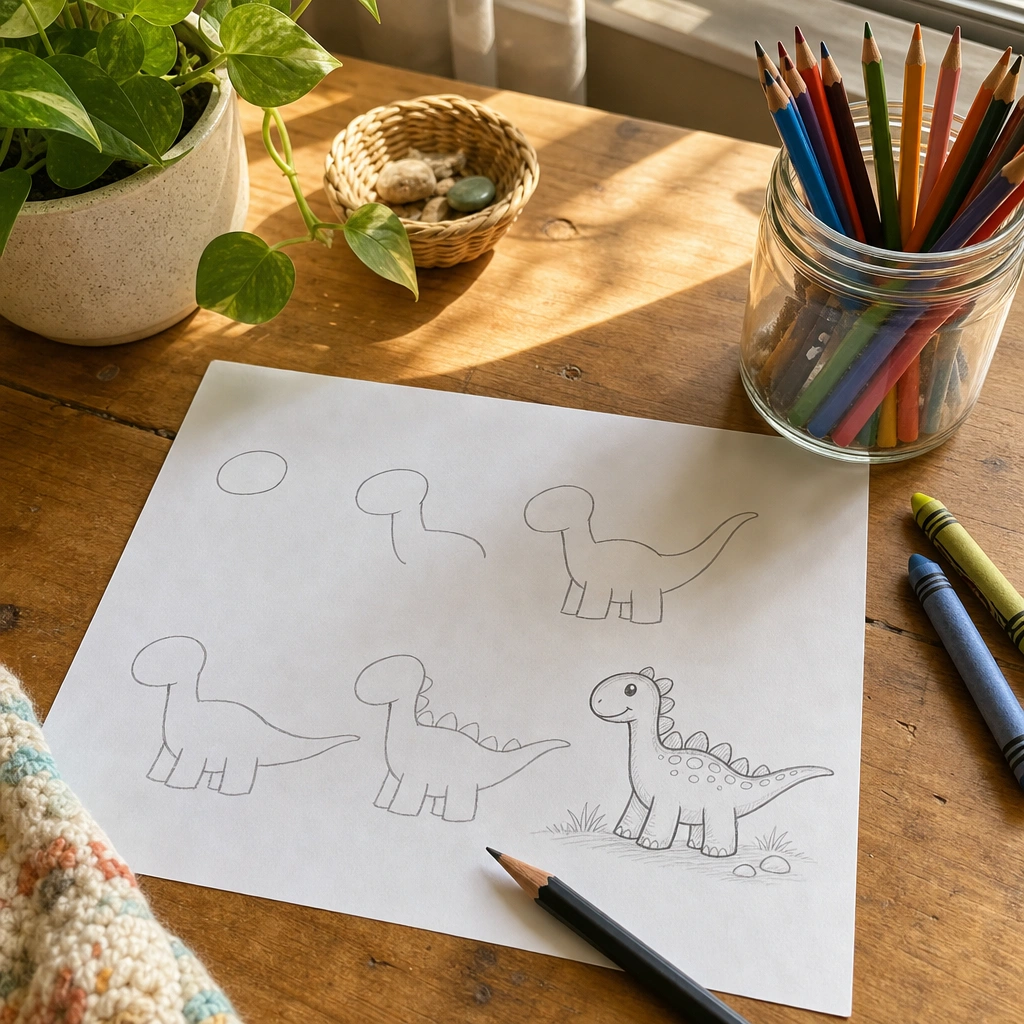
Here’s the full breakdown of how to draw a dinosaur for kids, step by step. Go slow, let your child draw their own lines (even wobbly ones — wobbly is charming), and remind them there’s no wrong way to draw a dinosaur.
Step 1: Draw the Body
Start with a big, slightly squished oval in the middle of the page. This becomes the dinosaur’s belly and chest. Leave plenty of room around it for the neck, tail, and legs you’ll add next.
Step 2: Add the Head
Draw a smaller oval near the top corner of the body oval, angled slightly. This will be the dinosaur’s head. Some kids like to make it round and friendly-looking; others want it long and snouty like a real dino. Both are correct!
Step 3: Connect with a Curvy Neck
Draw two curved lines connecting the head oval to the body oval, like a banana shape. This step is where the dinosaur really starts to take shape, and it’s often the moment kids get excited and want to keep going.
Step 4: Draw the Tail
From the opposite side of the body, draw a long shape that starts wide and tapers to a point. This is the tail. Curving it slightly upward makes the dinosaur look playful and mid-stomp rather than stiff.
Step 5: Add Four Sturdy Legs
Draw two thick, rounded rectangle shapes hanging down from the body for the front legs, and two slightly bigger ones for the back legs. Add rounded feet at the bottom of each leg — three little toe lines per foot is plenty of detail for young artists.
Step 6: Give It a Face
Add a big round eye, a smiling mouth, and maybe a couple of small triangle teeth peeking out. This is the step that turns a shape-blob into a character, and it’s usually everyone’s favorite part.
Step 7: Finish with Spikes, Scales, or Stripes
Now the fun details: triangle spikes down the back, little circle scales, or stripes along the tail. This is where kids can make their dinosaur totally their own — spotted, striped, rainbow-colored, whatever they like.
Once the pencil lines are done, trace over the final shape with marker or crayon and erase the extra guide lines. Then it’s coloring time.
A Simple Table: Dinosaur Types and How Hard They Are to Draw
| Dinosaur Type | Difficulty | Best For |
|---|---|---|
| Long-neck (Brontosaurus) | Easiest | Ages 3-6 |
| T. rex | Medium (tiny arms are tricky!) | Ages 5-8 |
| Stegosaurus | Medium (spikes take patience) | Ages 6-9 |
| Triceratops | Harder (horns and frill) | Ages 7+ |
If your child is just starting out, it’s worth letting them pick which dinosaur type looks most fun rather than assigning one based on skill level. Motivation tends to matter more than difficulty at this age — a determined five-year-old will happily wrestle with a Triceratops frill if they love Triceratops, while a bored eight-year-old might rush through an “easy” long-neck just to be done.
Simple Tips for Teaching Kids How to Draw a Dinosaur
Learning how to draw a dinosaur for kids is as much about confidence as it is about technique. Try these approaches to keep the experience relaxed and fun rather than frustrating.
- Draw alongside them. Kids relax when they see grown-ups make “imperfect” lines too.
- Talk through the shapes out loud. “Now a banana shape for the neck!” helps little ones follow along.
- Let them pick the dino personality. Fierce, silly, sleepy, or hungry — a story makes the drawing more fun.
- Skip the eraser pressure. Extra lines are part of learning, not mistakes to panic over.
- Celebrate the finished piece. Tape it to the fridge. Seriously, it matters to them.
One more honest tip: try not to “fix” their drawing partway through, even if you can see exactly where a line should go. It’s tempting to reach over and straighten a wobbly neck or nudge a leg into place, but kids notice when a grown-up takes over, and it quietly teaches them that their own version wasn’t good enough.
Narrating instead of correcting — “ooh, look at that curvy neck!” — keeps the ownership with them. It also helps to praise the process rather than just the result. Instead of only saying “that looks great,” try noticing effort: “I love how you figured out the spikes on your own” builds a very different kind of confidence than praise focused purely on the finished picture.

Turning Drawing Practice into a Full Craft Session
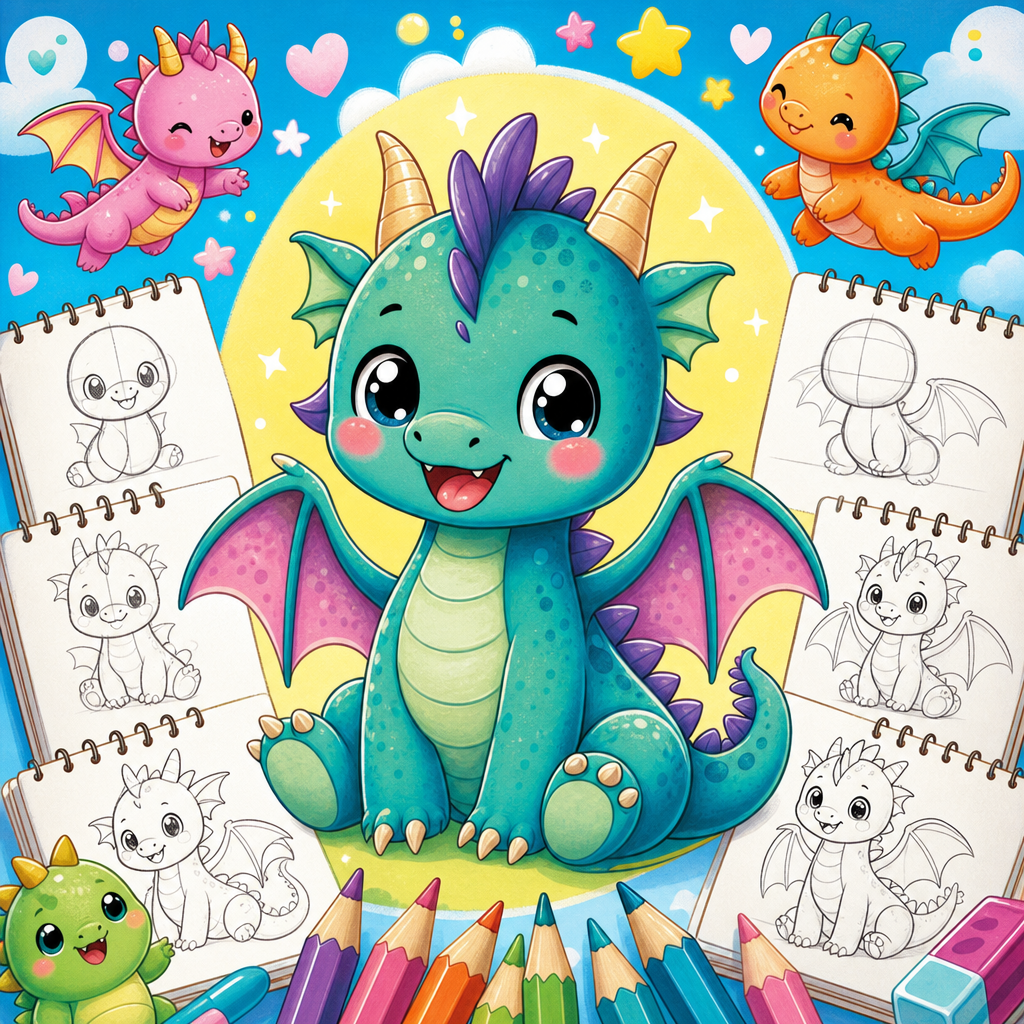
Once your child feels confident drawing a dinosaur freehand, you can extend the fun with printable practice sheets. Our How to Draw Dragons for Kids guide ($1.99, instant PDF download) uses the exact same shape-first method, just with wings and fire added — a natural next step once dinosaurs feel easy. It’s also a nice change of pace if your child loves both dinosaurs and dragons and wants to compare mythical creatures to prehistoric ones.
If you want to build a whole rainy-day activity around this, print a batch of dinosaur outline pages from our free coloring pages collection, let kids draw their own dinosaur first, then color both the free page and their own creation side by side. For printing tips so pages come out crisp and full-page every time, check our guide on how to print coloring pages at home.
You could even turn it into a mini “museum” afternoon: draw dinosaurs, color a few free printable pages, then set up a pretend gift shop with the finished art for stuffed animals to “buy.” Little additions like this stretch a fifteen-minute drawing activity into an hour of imaginative play without any extra planning on your part.
What If My Child Wants More Structure?
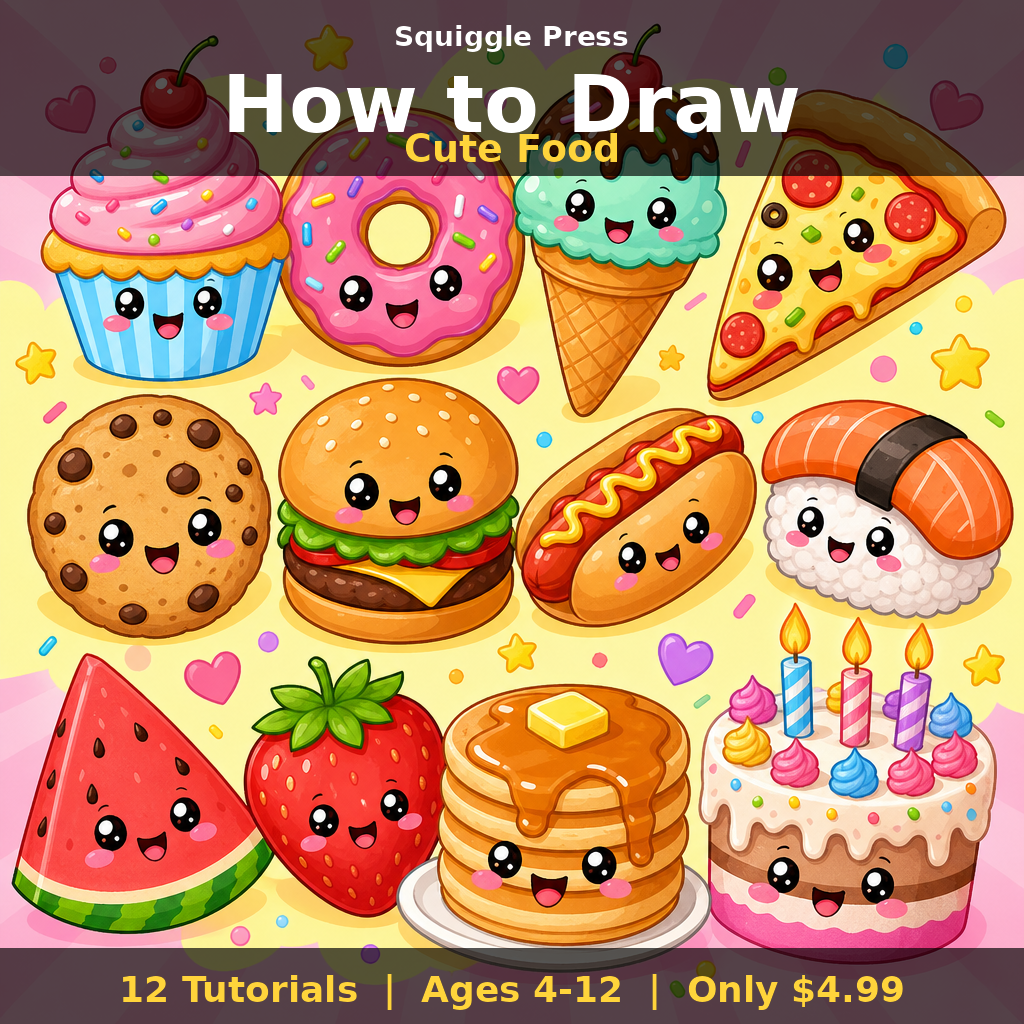
Some kids do best with a completely blank page and total creative freedom. Others feel more confident with light guide lines already printed for them to trace and build on — and that’s a completely normal preference, not a sign they’re “not artistic.” If your child is the second type, printable step-by-step tutorial packs are a gentle way to build the skill without the blank-page pressure. Browse our full shop for printable drawing tutorials and coloring books designed exactly for that purpose.
For kids who love drawing lots of different animals, our How to Draw Cute Sea Animals tutorial pack ($1.99, instant PDF download) uses the same shape-building steps for turtles, whales, and octopuses — a great follow-up once dinosaurs feel mastered.

Coloring the Finished Dinosaur
After the drawing is done, coloring is where a lot of kids really shine. There’s no rule that dinosaurs have to be green — purple stegosauruses and rainbow-striped T. rexes are extremely welcome around here. If your child enjoys layering colors or blending shades, our gel pen coloring techniques guide has simple tricks that work beautifully on dinosaur scales and spikes.
Younger siblings who aren’t quite ready for full drawing yet can still join in with coloring pages matched to their age and skill level — our guide to coloring pages by age is a handy starting point for figuring out what’s realistic for a 3-year-old versus a 7-year-old.
Making It a Family or Classroom Activity
Dinosaur drawing is a wonderful group activity because every kid’s dinosaur turns out different, even when everyone follows the same steps. Try setting up a “dino gallery” on the fridge or a classroom wall. It’s also a great quiet-time activity for car rides — pair it with our road trip activities for kids list for more screen-free ideas that travel well.
For siblings or classmates with a wide age range, mixing drawing practice with ready-made coloring pages keeps everyone engaged at their own level. Our coloring pages by age guide can help you pick pages that match each child’s current stage, whether they’re just scribbling shapes or ready for detailed line art.
Teachers and homeschool parents often like this activity because it doubles as a quiet science lesson. While kids draw, you can casually mention which dinosaurs were plant-eaters, which walked on two legs versus four, or how paleontologists actually figure out what a dinosaur looked like from bones alone. The drawing keeps hands busy while curiosity does the rest.
If you’re running this as a small group activity, consider giving each child a slightly different “mission” — one child draws the biggest dinosaur they can imagine, another draws the smallest, another gives their dinosaur an unusual color pattern. Small creative constraints like this tend to spark more original results than simply saying “draw a dinosaur,” and they make comparing everyone’s finished pictures at the end even more fun.
Common Questions Kids Ask While Drawing Dinosaurs
Kids often pause mid-drawing with questions like “why do dinosaurs have spikes?” or “did dinosaurs really look like this?” These are wonderful teachable moments. You don’t need to be a paleontologist — a quick, honest “scientists think so, based on fossils” is plenty. For families who want to go deeper, the Smithsonian’s natural history education resources publish kid-friendly dinosaur fact pages worth exploring together after the drawing is done.
Learning how to draw a dinosaur for kids often sparks bigger curiosity about prehistoric life, which is a lovely bonus beyond the art itself.
Troubleshooting: When Kids Get Frustrated Drawing a Dinosaur
If a dinosaur drawing isn’t going the way your child hoped, try these quick fixes:
- Legs look too skinny? Widen the rectangle shapes — thicker legs read as “sturdy dinosaur” instantly.
- Neck looks too straight? Add a slight curve; even a small bend adds movement.
- Whole dinosaur looks “off”? That’s normal — encourage a second attempt instead of erasing the first one to shreds. Comparing versions is part of learning.
- Losing interest halfway through? Switch to coloring the parts already drawn, then finish the rest later.
It also helps to remember that frustration is often a sign your child is trying something slightly outside their comfort zone, which is actually a good thing developmentally. A short break, a snack, or simply switching to a smaller, simpler dinosaur for a “win” before returning to the trickier one can reset the mood in minutes.
If frustration shows up regularly, it can also help to slow the whole process down even further. Instead of doing all seven steps in one sitting, try spreading them across two short sessions — shapes and neck on day one, legs and tail on day two, face and details on day three. Breaking a project up like this keeps each sitting short enough that a child rarely has time to get overwhelmed, and it turns one drawing into several days of small, satisfying wins.
Complete Recap: The 7 Steps for How to Draw a Dinosaur for Kids
- Draw the body oval
- Add the head oval
- Connect with a curvy neck
- Draw the tapering tail
- Add four sturdy legs
- Give it a face
- Finish with spikes, scales, or stripes
That’s genuinely the whole method behind how to draw a dinosaur for kids — shapes first, personality second, details last. Once your child has this pattern down, they can apply it to almost any animal, dinosaur or otherwise.
Final Thoughts on Teaching Kids to Draw Dinosaurs
Drawing a dinosaur doesn’t need to be intimidating for kids or the grown-ups helping them. With a few simple shapes, a little patience, and zero pressure for perfection, almost any child can create a dinosaur they’re proud of. If your family enjoys this kind of step-by-step creative project, take a look at our full shop for more printable drawing tutorials, coloring books, and sticker packs — all instant PDF downloads starting at just $1.99.
How to Draw a Dinosaur for Kids — FAQ
What is the easiest dinosaur to draw for kids?
A long-necked dinosaur like a Brontosaurus is often easiest because it’s built from just two ovals and a curved neck and tail, with no tricky spikes or horns needed.
What age can kids start learning to draw dinosaurs?
Most children can start tracing and copying simple shape-based dinosaurs around age 4-5, once they can confidently draw circles and lines, per early childhood drawing development guidelines from child development researchers.
What supplies do I need to draw a dinosaur?
All you need is plain or printer paper, a pencil, an eraser, and something to color with — crayons, markers, or colored pencils all work great for finishing a dinosaur drawing.
How can I make dinosaur drawing easier for younger kids?
Use printable step-by-step tutorial sheets or tracing pages so younger kids can follow pre-drawn light guide lines instead of starting from a blank page.
Ready to print some fun?
Browse our printable coloring books, drawing tutorials & sticker packs — instant PDF downloads from $1.99, plus totally free tutorials to try first.

Every Squiggle Press book — 40 printable PDFs for $9.99
Kids coloring books, adult coloring books, drawing tutorials & sticker packs. $160 value. Print unlimited copies forever.
Get the bundle →