Picking coloring pages by age is half the reason coloring time goes well or badly. The wrong page at the wrong age is why your toddler scribbles for thirty seconds and your eight-year-old calls it babyish. Below: a real parent-tested guide to coloring pages by age, with what to print at each stage and what to skip.
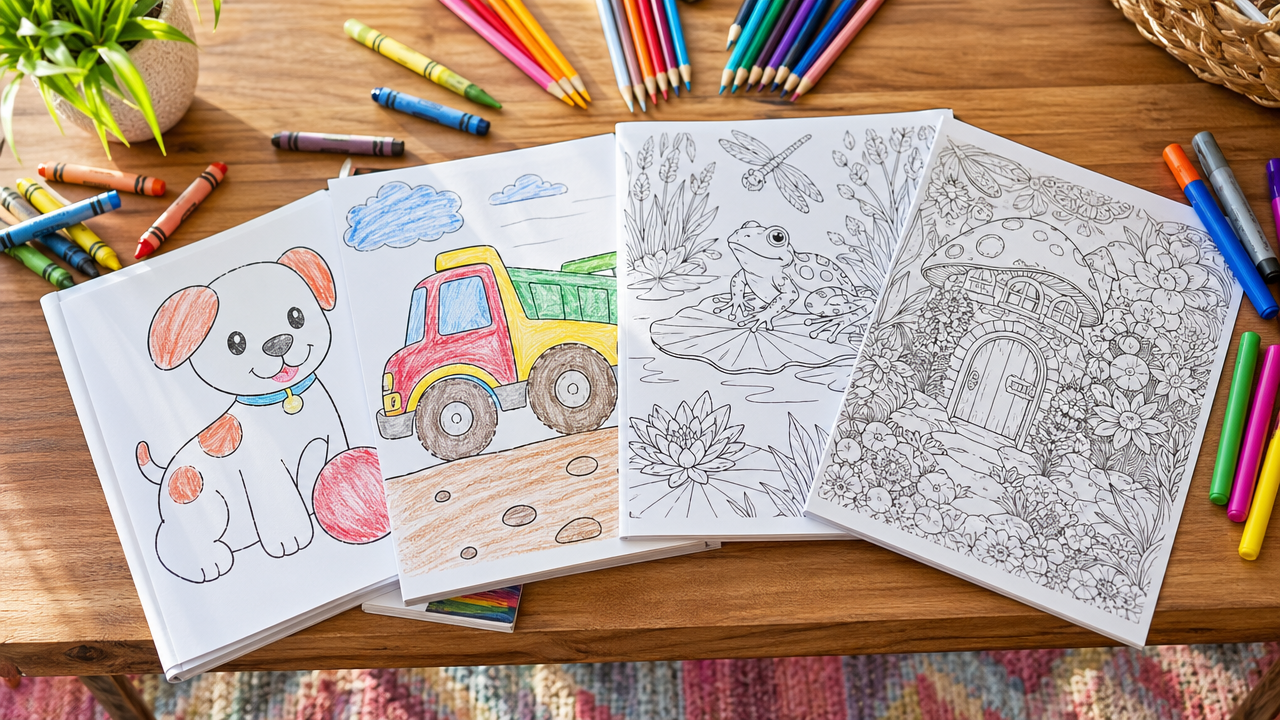
I’ve been buying, printing, and watching my kids ignore coloring pages for long enough now to have a strong opinion about which ones actually work at which age. Most of the “coloring pages by age” guides online are written by people who haven’t watched a 3-year-old try to color a 200-line mandala. So here’s a more honest take, age by age, with what to look for and what to skip.
Why Picking Coloring Pages by Age Actually Matters
The single biggest factor in whether your kid sticks with coloring is matching the page complexity to where they are developmentally. Coloring pages by age is not a marketing label — it is a real difference between fun for thirty minutes and abandoned in thirty seconds.
Ages 2 and Under: Mostly Don’t Bother (Yet)
Real talk: most kids under 2 aren’t coloring. They’re scribbling, gripping a crayon in their fist, and getting more wax on the table than the page. That’s developmentally fine — it’s how they figure out grip strength. But “coloring pages” as a category isn’t really for them yet.
If you want to do something at this age, give them a big blank piece of paper and chunky crayons. Save the printables for later. The exception is if you want a simple, big-shape page they can stab at while you’re trying to make dinner. In that case, the simpler the better — one big animal, thick outline, no inner details.
Ages 2-3 (Toddlers): Big Shapes, Thick Lines, Forgiving Subjects
This is where coloring starts to be a thing. The rule for this age: fewer details, thicker outlines, recognizable subjects. Toddlers love coloring things they can name — a cat, a fish, a flower, a car. They don’t want a complicated scene. They want one thing, big.
What to look for:
- One main subject per page
- Outlines at least 2-3mm thick
- Big internal areas to color in (no tiny details)
- Familiar subjects — animals, food, vehicles, family
What to skip: anything described as “intricate” or “detailed.” Anything with text inside the lines. Anything where the artist clearly designed it for an older kid and just slapped a “Toddler” label on the cover.
Our free coloring pages include a few simple animal pages that work well at this age. Print one, hand it over with three crayons, walk away.
Ages 4-5 (Preschool): Detail Starts to Matter
Around 4, something flips. Kids start caring about staying inside the lines, and they start wanting to color things with personality. This is the age where “cute” wins. Cute animals. Cute princesses. Cute dinosaurs. The cuter the better.
What works at 4-5:
- Cartoon-style characters with expressive faces
- Simple scenes — one character in a recognizable setting (a bunny in a garden, a fish in the ocean)
- Themed sets so they can color “all the dinosaurs” or “all the princesses”
- Outlines around 1-2mm thick
Themed coloring books really start to land here. We’ve found that having a set of 12-15 connected pages is much more engaging at this age than a random pile of unrelated images. They want to “do the whole book.”
Ages 6-7: Story-Driven Pages and More Complex Scenes
At 6-7, kids have the fine motor skills for genuinely detailed pages, and they have the attention span to spend 20-30 minutes on one. This is the sweet spot for themed coloring books. They love finishing things. They love a series.
What works at 6-7:
- Themed sets — sea creatures, jungle animals, space, fairy tales
- Action scenes (a knight fighting a dragon, an astronaut on the moon)
- Pages with multiple characters or background elements
- Step-by-step drawing tutorials — they can both color AND learn to draw
This is also the age where I’d start introducing drawing tutorials, not just coloring. Kids at 6-7 have the patience to follow a 6-step “how to draw a chocobo / lion / unicorn” guide, and the result is a drawing they made themselves. Big confidence win.
Ages 8-10: Detail, Skill-Building, and Adult-Adjacent Themes
By 8, a lot of kids have outgrown the cartoon-style coloring book. They want pages that look more “grown up.” That doesn’t mean adult mandalas — it means more detailed, more realistic, with elements they can actually shade.
What works at 8-10:
- More realistic animal illustrations (not cartoon)
- Mythical creatures — dragons, phoenixes, wolves, mythological beasts
- Complex scenes with backgrounds and depth
- Mandala-adjacent geometric pages
- Sticker books — yes, still. Kids this age love decorative sticker journaling.
The crossover zone here is interesting. A lot of 9-10-year-olds enjoy “tween-friendly” adult coloring books — moderately complex mandalas, intricate animal portraits, fantasy themes. If a page would work for a stressed adult, it’ll often work for a 10-year-old.
What’s the Same at Every Age
A few rules hold no matter the age:
Quality of the line art matters more than the subject. A clean, well-drawn cat will get more attention than a poorly drawn dinosaur, even if your kid loves dinosaurs. Bad line art is frustrating to color — kids feel it even if they can’t articulate it.
Print quality matters. Faded, low-resolution prints look bad and feel cheap. If you’re going to print at home, use at least 24lb paper and the highest quality print setting. (We have a guide on how to print coloring books at home coming soon, but the short version is: don’t print on regular 20lb copy paper if you want it to feel nice.)
Themed sets beat random pages. At every age, kids engage more with a connected set than a one-off page. “Color all the ocean animals” is a project. “Color this fish” is a chore.
What to Avoid (At Any Age)
- Pages with text inside the lines. The kid is going to color over it anyway, and now the line art looks weird.
- Pages that are 90% empty space and 10% subject. Looks lazy, kids notice.
- “Pre-colored” examples on the same page as the line art. Robs the kid of the choice.
- Mandalas marketed at toddlers. They’re not going to color a mandala. Stop trying.
The Quick Cheat Sheet
- 2-3: Big simple shapes, one subject per page, thick outlines
- 4-5: Cartoon characters with personality, themed sets, “cute” wins
- 6-7: Themed coloring books, drawing tutorials, multi-character scenes
- 8-10: More realism, mythical creatures, mandala-adjacent designs
If you want to try our age-appropriate sets, the full Squiggle Press shop is sorted by theme. Toddler-friendly stuff lives in the simpler animal sets, kids 6+ tend to love the themed adventure books, and the older crowd gravitates to our mythical-creature drawing tutorials. All printable, all instant download — print as many as you want, color forever.
If you’ve found pages that hit at a specific age that aren’t on this list, I want to hear about it. The “what works at 5” question changes faster than you’d think — what worked for my older kid at 5 didn’t always work for the younger one. Coloring is more individual than guides like this make it sound.
Further Reading
If you want to dig deeper into coloring pages by age, these external resources are worth a read:
- AAP HealthyChildren on age-appropriate coloring
- ZERO TO THREE on early childhood art
- NAEYC on art for young children
Quick Reference: Coloring Pages By Age
Here is the at-a-glance answer for coloring pages by age:
- What works best for coloring pages by age: Quality over quantity, every time. Pick coloring pages by age that match your kid’s age and interests, not the most pages.
- Where to find coloring pages by age: Squiggle Press has a curated set of coloring pages by age as instant-download PDFs at squiggle-press.com.
- Best paper for coloring pages by age: 24lb minimum for crayons and colored pencils, 32lb for markers. Standard copy paper buckles.
- Print settings for coloring pages by age: Set print quality to High and force black-only ink for the cleanest line art.
- Cost of coloring pages by age: Free options work for casual use; paid coloring pages by age ($1.99-$4.99) are worth it when you want a complete themed set.