
Some links below are affiliate links. If you buy through them we may earn a small commission at no cost to you.
If you’ve stood in the craft aisle staring at two wall displays of markers, wondering why one twin-tip set costs $4 and another costs $60, you’re not alone. The alcohol markers vs water based question comes up in our inbox constantly, usually from a parent who just watched their kid’s brand-new coloring page bleed through onto the kitchen table. So let’s settle it once and for all: alcohol markers vs water based markers each have their place, and the “right” choice depends on who’s coloring, what they’re coloring on, and how much cleanup you’re up for tonight.
This guide walks through every practical difference we’ve learned from years of testing both marker types with real kids, real teenagers, and a few adult colorists in our own family. By the end, you’ll know exactly which marker to grab for which project, which paper to pair it with, and how to keep both types happy on the same craft table. We’ll also cover the alcohol markers vs water based question by age, by budget, and by paper type, so you can skip straight to the section that matches tonight’s craft table dilemma.
The short answer: alcohol markers vs water based at a glance
Water-based markers are the better everyday choice for most kids ages 3-12: they’re cheaper, non-toxic, low-odor, and wash out of clothes and skin. Alcohol markers (like Copic or Ohuhu) are better for older kids, teens, and adults who want smooth, blendable color on marker-specific paper — but they cost more, smell stronger, and bleed through regular printer paper almost every time. If you’re coloring printable PDF pages at home with young children, start with water-based. Upgrade to alcohol markers once someone in the house is asking for blending techniques.
It helps to think of the alcohol markers vs water based decision less as “which is better” and more as “which is better for this project, this week, this kid.” A five-year-old coloring a unicorn page needs washable, forgiving ink. A sixteen-year-old shading a detailed mandala wants smooth blending and doesn’t mind the smell or the price tag. Both answers are correct — they’re just correct for different people.
What’s actually different about alcohol markers vs water based markers
The name gives it away: the difference comes down to what carries the pigment or dye onto the paper. Alcohol markers use an alcohol-based solvent that dries fast and blends smoothly into itself, almost like paint. Water-based markers use, well, water as the carrier, so they dry a little slower, don’t blend as seamlessly, but are far gentler on skin, clothing, and little lungs.
Understanding this one chemistry fact explains almost every other difference on this list — smell, bleed-through, price, and cleanup all trace back to that carrier liquid. It’s also why the two marker types behave so differently once ink actually hits paper, which we’ll get into below.
| Feature | Alcohol Markers | Water-Based Markers |
|---|---|---|
| Typical price (set of 24) | $25-$80 | $4-$15 |
| Smell | Strong, chemical | Mild to none |
| Blending | Very smooth | Streaky unless layered carefully |
| Bleed-through on regular paper | Heavy, needs marker paper | Light to moderate |
| Washability | Stains clothing/skin | Washes out easily |
| Best age range | 10+ years, teens, adults | 3-12 years |
Why smell and safety matter more than you’d think
Alcohol markers give off fumes that are noticeably stronger than water-based ones, especially in a closed bedroom or a car. Most brands are non-toxic when used as intended, but the fumes can bother sensitive noses, and prolonged use in a small room without airflow isn’t ideal for young kids. The American Academy of Pediatrics offers general guidance on choosing safe art materials for children at healthychildren.org, and the short version is: read labels, ventilate the room, and match the tool to the child’s age. Water-based markers rarely raise these concerns at all.



A quick safety checklist for alcohol markers vs water based markers
- Check the packaging for “AP Non-Toxic” or “ASTM D-4236” certification
- Color near an open window or fan when using alcohol markers
- Keep caps on tight — alcohol markers dry out fast when left open
- Supervise younger siblings so caps and small parts don’t end up in mouths
- Have a damp cloth handy for water-based marker spills (they wipe up in seconds)

Bleed-through: the reason your printable pages matter
This is where the alcohol markers vs water based debate gets very real for anyone printing PDF coloring pages at home. Alcohol markers are notorious for soaking straight through standard 20lb printer paper, leaving ghost outlines (and sometimes stains) on the table underneath. Water-based markers bleed less, but they can still seep through thin paper if a child presses hard or goes over the same spot repeatedly. Either way, paper choice changes everything.
If you’re coloring with alcohol markers regularly, look into dedicated marker paper or card stock — we go deeper into paper options in our guide to the best coloring paper for watercolor, much of which also applies to marker work.
A cheap fix that works for both marker types: slide a spare sheet of scrap paper or an old magazine page underneath whatever you’re coloring. It catches bleed-through before it reaches the table, and it means you can reuse your favorite printable pages without worrying about damaging the surface below. Our free coloring pages are a great low-stakes place to test a new marker set before committing it to a page you really love.
Blending: the skill that separates the two marker types
Alcohol markers are built for blending. Because the solvent stays workable for a few seconds after it hits the page, colors melt into each other, creating smooth gradients that look almost airbrushed. This is a huge part of why professional illustrators and older hobbyists love brands like Copic.
Water-based markers can blend too, especially the “brush tip” or dual-tip varieties, but it takes more patience — usually layering light colors first, then going darker while the first layer is still slightly damp, and working fast before it dries completely.
Simple blending tips for water-based markers
- Start with your lightest color and build up gradually
- Work in small sections so the ink stays wet long enough to blend
- Use a blending pen or a damp (not wet) cotton swab to soften harsh lines
- Let one layer dry for a few seconds before adding shadow tones on top
- Practice on a scrap page before tackling a page you care about
If your child is genuinely excited about shading and gradients, that curiosity is worth nurturing — it’s often a sign they’re ready for slightly more advanced supplies or techniques. Our How to Draw Cute Sea Animals printable tutorial ($1.99, instant PDF download) is a gentle way to practice shading and line work before ever touching a $60 marker set.

Cost: is the alcohol markers vs water based price gap worth it?
Let’s talk numbers, because this is often the deciding factor for families. A basic 24-pack of water-based markers runs $4 to $15 and lasts a surprisingly long time if caps get put back on. A comparable 24-pack of true alcohol markers — the kind with replaceable nibs and refillable ink — starts around $30 and can climb past $100 for professional sets. That price buys better blending, richer pigment, and markers that don’t dry out as quickly, but it’s a real investment, especially for a household with more than one artist.
Our honest take: most kids under 10 won’t notice or care about the blending difference nearly as much as a parent budgeting for art supplies will care about the price difference. Save the alcohol marker investment for a birthday gift, a middle schooler’s serious hobby, or an adult who’s already fallen for coloring as a stress-relief ritual. In fact, if stress relief is the goal, our piece on the best coloring pages for stress pairs nicely with either marker type — the calming effect comes from the coloring itself, not the price tag of the pen.
One more budget note worth mentioning: alcohol markers are often sold individually, not just in sets, so you can build a collection slowly by replacing colors as they run dry, rather than buying a whole new set every time. Water-based markers are rarely sold this way, since the sets are cheap enough that replacing the whole box makes more sense.
Which age group should use which marker: alcohol markers vs water based by age
Age isn’t a strict rule, but it’s a genuinely useful starting point when you’re standing in the store deciding what to buy. Younger kids need forgiving, washable, low-odor tools. Older kids and teens who’ve developed patience and fine motor control get more out of markers that reward technique. Here’s how we’d break it down for most families.
| Age Range | Recommended Marker Type | Why |
|---|---|---|
| 3-5 years | Water-based, chunky grip | Washable, low fume risk, easy to hold |
| 6-9 years | Water-based, brush or dual tip | Builds control, still low-mess |
| 10-12 years | Water-based or entry-level alcohol | Ready to experiment with blending |
| Teens/Adults | Alcohol markers | Best for shading, gradients, hobby-level detail |
For the youngest coloring fans, we’d also point you toward our Magical Unicorns Coloring Book ($1.99, instant PDF download) — bold, simple outlines that hold up beautifully under everyday water-based markers, no bleed-through drama. And for a slightly older, dragon-obsessed crowd looking to combine drawing and coloring skills, How to Draw Dragons for Kids ($1.99) is a fun bridge project.
Alcohol markers vs water based: what changes for adult coloring books
Adult coloring books tend to have finer lines, more intricate patterns, and a lot more surface area to blend — mandalas, florals, cottagecore scenes, that sort of thing. This is exactly the environment where alcohol markers shine, because their smooth blending really pays off on detailed line art. If you’re an adult colorist debating alcohol markers vs water based for your next project, consider what you’re coloring first. A dense mandala with lots of tiny sections benefits from alcohol marker precision and blend quality, while a looser botanical illustration can look gorgeous with either.
Our Mandala Magic Adult Coloring Book ($1.99, instant PDF download) and Vintage Botanical Plates Adult Coloring Book ($1.99) are both printed on line work sturdy enough for either marker type, though we’d suggest printing on heavier card stock if you’re going the alcohol marker route to avoid bleed-through. If you love the cozy, nostalgic aesthetic, our cottagecore coloring pages collection is another lovely candidate for slow, blended alcohol marker sessions.
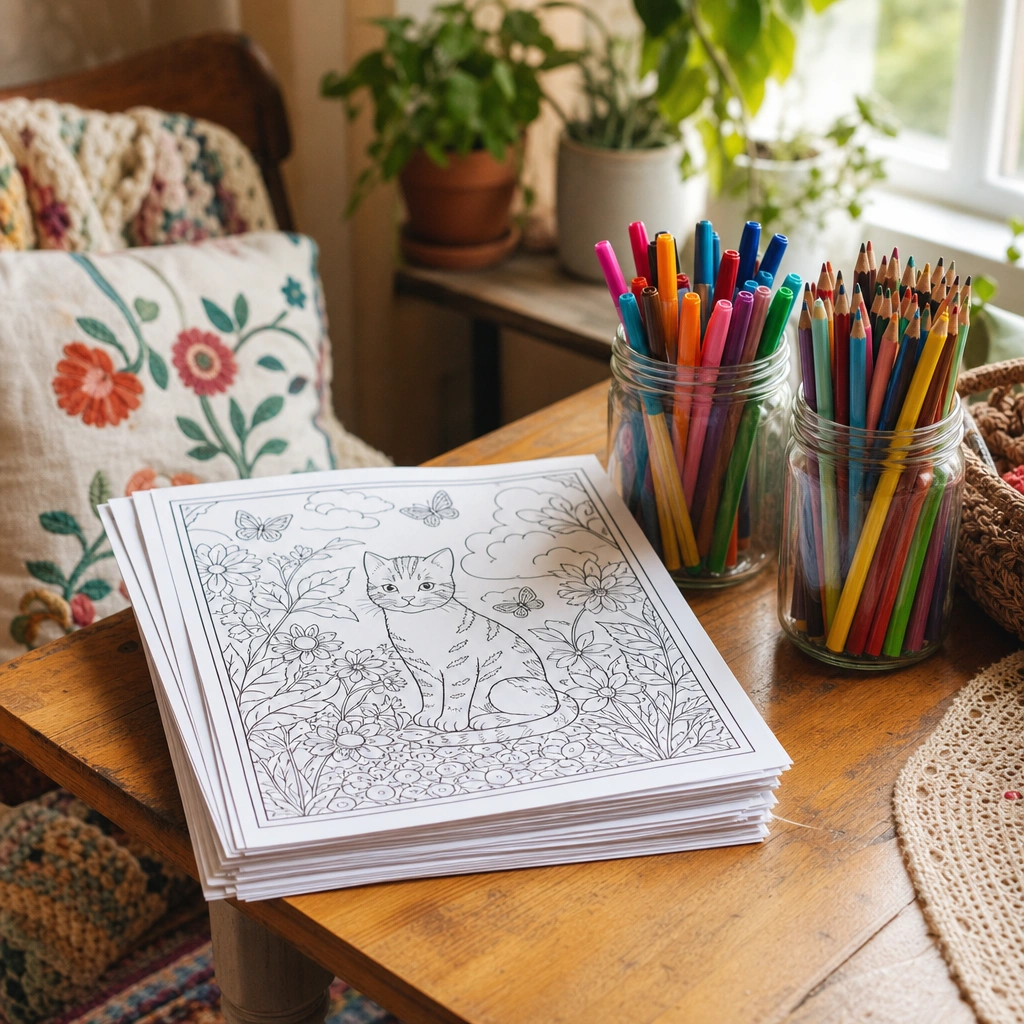
Setting up a coloring station that works for both marker types
If your household has both a water-based-marker toddler and an alcohol-marker teenager, you don’t need two separate craft rooms — just a smart setup. Keep alcohol markers stored upright with caps sealed tight (they dry out faster than water-based ones), and store both types away from direct sunlight and heat, which can affect ink consistency over time. A dedicated tray or caddy per person prevents the classic “someone used my good markers and now they’re dry” argument.
We wrote a full walkthrough on this exact challenge in how to organize a coloring supply station, which covers storage for markers, pencils, and paper together. A protective mat or a stack of scrap paper underneath is non-negotiable if alcohol markers are in the mix — it’s the single easiest way to protect furniture. Cardstock backing sheets, cheap cutting mats, or even a folded towel all work fine. This one small habit prevents almost every “why is there a marker stain on the table” conversation before it starts.
Caring for and storing each marker type
A little maintenance goes a long way toward making either marker investment last longer, and the care routines are genuinely different for each type.
Caring for alcohol markers
Alcohol markers dry out faster than most people expect, mostly because that solvent carrier evaporates quickly once a cap is left loose. Store them horizontally rather than standing up — this keeps the ink evenly distributed around the nib instead of pooling at one end, which helps prevent streaky, uneven color the next time you use them. If a nib does start to dry out, a few drops of marker refill ink (sold separately for most brands) can revive it instead of forcing a full replacement.
Caring for water-based markers
Water-based markers are more forgiving, but they’re not indestructible. Always press the cap until it clicks, store them tip-down when possible so the ink stays near the nib, and keep them away from direct heat sources like a sunny windowsill or a car dashboard, which can thicken the ink over time. If a water-based marker seems dry, a drop of plain water on the tip often brings it right back to life — a trick that simply doesn’t work with alcohol markers.
Common myths about alcohol markers vs water based markers
A few misconceptions keep circulating in coloring communities, so let’s clear them up plainly:
- Myth: Alcohol markers are always better quality. Not true — quality depends on the brand, not just the carrier liquid. Some water-based brush markers rival alcohol markers in pigment richness.
- Myth: Water-based markers never bleed. They bleed less, but thin paper and heavy pressure can still cause seep-through.
- Myth: Kids can’t use alcohol markers at all. Older kids with supervision and ventilation can use them fine; it’s more about maturity and fine motor skill than a strict age cutoff.
- Myth: You need alcohol markers to get vibrant color. Modern water-based dual-tip markers have come a long way and can produce genuinely vivid, saturated results.
- Myth: Alcohol markers and water-based markers can be mixed freely on the same page. They can be combined, but alcohol marker ink can sometimes smear water-based lines underneath it, so it’s worth testing on scrap paper first if you’re layering the two.
Frequently asked questions about alcohol markers vs water based markers
Can you use alcohol markers and water-based markers on the same page?
Yes, many colorists do this to get the best of both — water-based for large background areas and alcohol markers for small, detailed blending work. Just test on a scrap corner first, since alcohol ink can sometimes lift or smear water-based lines underneath it.
Do alcohol markers ruin regular coloring books?
They can, mostly through bleed-through onto whatever page is underneath. The coloring page itself is usually fine, but the page behind it (or the table below) often isn’t, unless you’re using a backing sheet.
Are water-based markers washable out of clothing?
Most water-based markers marketed as “washable” do rinse out of clothing with regular laundry detergent, especially if treated before the stain dries. Alcohol marker stains, by contrast, are usually permanent on fabric.
Which lasts longer, alcohol markers or water-based markers?
Alcohol markers dry out faster if caps are left off, but many brands offer refillable ink, so a well-maintained alcohol marker can technically last for years. Water-based markers are more forgiving day-to-day but usually aren’t refillable once they’re truly out of ink.
Do I need special paper for alcohol markers vs water based markers?
For alcohol markers, yes — dedicated marker paper or heavy card stock prevents bleed-through and helps colors blend more smoothly. Water-based markers are far more forgiving and work fine on standard printer paper, though a backing sheet is still a smart habit for both.
A simple decision guide
Still torn? Ask yourself these three questions, and let the answers guide the alcohol markers vs water based decision for your household.
- Who’s coloring most often? Young kids: water-based. Teens/adults chasing blending skills: alcohol.
- What paper are you using? Regular printer paper: stick with water-based, or add a backing sheet either way. Heavy cardstock or dedicated marker paper: alcohol markers become viable.
- What’s your budget and tolerance for smell? Tight budget or sensitive noses: water-based, every time.
Whichever you choose, the goal is the same one we care about most at Squiggle Press: more relaxed, screen-free time spent creating something together. If you want a low-pressure place to test out a new marker set on printable pages before committing to a full coloring book, browse our free coloring pages first, then explore the full shop for themed printable coloring books, drawing tutorials, and sticker packs starting at $1.99. For younger sticker fans who love decorating pages without any marker mess at all, our Cute Cat Sticker Pack ($1.99, instant PDF download) is a great mess-free alternative on marker-heavy days.
Every family’s coloring table looks a little different, and that’s exactly how it should be. Some households will stock both marker types side by side for years; others will settle firmly into one camp. Either way, understanding the real, practical differences behind alcohol markers vs water based markers means you’re buying based on what actually works for your kids and your kitchen table — not just whichever set has the flashiest packaging at the store.
Ready to print some fun?
Browse our printable coloring books, drawing tutorials & sticker packs — instant PDF downloads from $1.99, plus totally free tutorials to try first.

Every Squiggle Press book — 40 printable PDFs for $9.99
Kids coloring books, adult coloring books, drawing tutorials & sticker packs. $160 value. Print unlimited copies forever.
Get the bundle →